
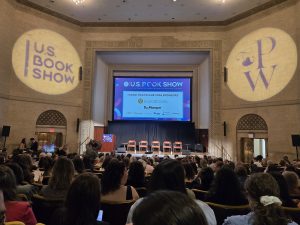
The U.S. Book Show, hosted by Publishers Weekly, returned to New York City on Wednesday, June 3, bringing publishing professionals together at the New York Academy of Medicine for a day of sessions about where the industry is headed and how it can adapt without losing sight of the humanity that is integral to its success.
A theme running consistently through the day’s sessions was that publishing is being pushed to evolve on multiple fronts at once. During the opening keynote, “CEOs in Conversation,” Dominique Raccah, Publisher and CEO of Sourcebooks, David Shelley, CEO, Hachette Book Group US and Hachette UK, and Madeline McIntosh, co-founder, CEO and publisher of Authors’ Equity each framed AI as both an opportunity and a source of real risk. Madeline McIntosh described the technology as a force that can help publishers, but also one that leaves every company mere minutes away from controversy if used carelessly. Dominique Raccah pointed to copyright as one of the biggest areas of concern, while David Shelley drew a useful distinction between creative uses of AI and operational ones, arguing that the industry should embrace the use of AI in areas like customer service and workflow efficiency without letting technology overrun the creative and curatorial heart of publishing.
When the conversation turned to the types of people and roles that publishers are looking for in this rapidly changing space, the three executives offered a broader picture of how their organizations are thinking about talent and culture. Each of them ascribed a high value to traits including curiosity, agility, and what McIntosh called an “expert generalist” mindset. There was a strong emphasis on employees who want to continue learning, an appreciation for flexibility, and the ability to work across departments, essentially breaking down the silo structure that persists in many organizations. Remote work and project-based collaboration were mentioned as important ways for companies to widen access to talent, while diversity and representation were framed not only as cultural goals, but as business imperatives with a direct and positive impact on growth.
The balance between innovation and protection surfaced throughout the day’s sessions, with panelists emphasizing that AI use needs defined guardrails, that authors and copyrighted works must be protected, and that human judgment still must anchor the process from beginning to end. The tone of the conversations was pragmatic: publishers cannot afford to sit on the sidelines, but they also shouldn’t ignore questions of originality, trust, and reader connection.
Equally striking was the way speakers connected technology back to discoverability. Several panelists noted that publishing does not have a content problem so much as a discoverability one. Readers still struggle to find the right book at the right time, and the resounding message was that while technology can help, it needs to be used in the service of matching books with readers more thoughtfully and more effectively.
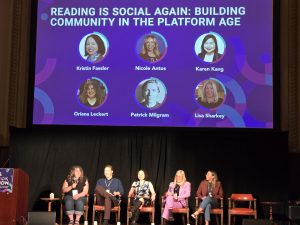 This theme carried over into the session: “Reading is Social Again: Building Community in the Platform Age”. Speakers from Podium, Substack, TikTok, Penguin Random House, and Kickstarter each stressed that audience-building is no longer only about promotion in the leadup to book launch. Instead, it is about sustained and authentic engagement, by understanding where readers and fans already gather and connecting with them in those online venues. The advice was notably practical: focus on quality over quantity, use content intentionally across platforms, be transparent with authors, and remember that digital community works best when it is rooted in real relationships rather than performative reach.
Panelists also explored the idea of what constitutes effective strategy for various platforms. TikTok tends to reward content with authenticity over polish, while Substack was framed as a space for deeper, longer-term relationships between authors and subscribers. Facebook groups and creator communities were still seen as highly valuable, especially in spaces that cultivate discussion and trust by individuals with expertise in a specific subject area or those with a strong community following. The consistent takeaway was that social storytelling works best when it is genuine and that authors and publishers should think less about broadcasting and more about building connection over time.
The panel discussion, “Beyond Launch: Mastering Discovery for Backlist” provided a useful reminder that with 80% of publishing revenues coming from backlist, publishers ignore this important source of sales at their peril. Speakers noted that metadata, positioning, and interdepartmental alignment are far more important than many teams may assume in helping drive backlist sales. The conversation underscored that the industry now has more data than ever, but success still requires quick action, recognizing cultural moments as they happen, and ensuring editorial, sales, and marketing teams are using aligned strategies. Clean metadata, clear keywording, and better category positioning were presented not as back-end housekeeping tasks but as central ingredients to help in title discovery. The takeaway was refreshingly direct: Do not overthink the process but do treat the underlying information as essential for allowing books to surface for new readers at the right time.
The overall mood of this year’s US Book Show was one of cautious optimism. The concerns raised were real, especially around copyright, plagiarism, discoverability, and the risks of moving too quickly with new tools. Even so, the tone was forward-looking, with speakers often returning to the idea that publishing is at a pivotal moment, one in which the industry has an opportunity to reshape how readers discover books, how authors are supported, and how publishing teams can work better.
There was also a strong undercurrent of confidence about the enduring value of books. Even as conversations centered on platforms, data, and AI, panelists pointed to continued appetite for print, the social nature of reading, and the importance of culture-making work. For an industry that often talks about disruption in anxious terms, the U.S. Book Show offered a constructive reminder that adaptation does not have to come at the expense of editorial judgment, reader trust, or the distinctive human sensibility that makes publishing matter.
For attendees, the US Book Show provided a useful snapshot of an industry that is trying to be both thoughtful and nimble. And for anyone who missed it, the strongest message from the day was clear: Publishing’s future will belong to the teams that can use new tools intelligently, strengthen discovery, invest in authentic community, and keep people at the center of the work.