 The Westchester team – with representation from our offices in the US, UK, and India – had a very busy London Book Fair. The Olympia, for all of its pros and cons, has been a hub for our industry for over a decade, and it will be a culture shock to shift to the Excel next year. (For a look back on that, please check out this LinkedIn post.)
Publishers Weekly and The Bookseller did fantastic jobs with their coverage of the Fair. Key topics that the attendees were discussing were AI (for and against), accessibility (with a phenomenal session moderated by Simon Mellins including publishing experts like Princeton University Press’ Cathy Felgar), print on demand, and global disruptions to our industry. The above linked articles do a good job showing what was being discussed in panels and on the floor, and I encourage you to check out their coverage.
For this final year at Olympia, what was on publishers’ minds? We met with over 60 publishers and these were the top topics:
- Accessibility – While many publishers may feel they’ve heard it all about accessibility at this point, the adoption of ADA Title II, and its expected impact on library acquisitions in the US provided an opportunity to reaffirm workflow decisions, talk about their backlists and what they may wish to do to ensure futureproofing their files, including the potential AI offers to address alt text and language shift tagging needs.
- AI – As a recent PwC commercial represented, it sure does feel like everybody’s trying to wedge ‘AI’ into their product descriptions and solutions the way everyone said ‘blockchain’ about 8 years ago or ‘AR/VR’ about 10 years ago. That being said, one publisher caught some flak for saying that AI is a worker skill that we can’t ignore (see PW article above), and they’re not wrong. As an industry we have every right to be concerned about AI due to the lawsuits against Gen AI platforms that enthusiastically abused publishers’ intellectual property. But, learning and – where appropriate – putting into practice AI skills in the workplace will be our industry’s competitive gap as compared to other media verticals like recording, film, and journalism that have in some cases advanced the use of non-content-led AI within their workplace. Comparing documents from business partners, answering questions (with attribution) regarding complex topics, doing market analysis, and more are business needs that any business has. Our discussions around AI have emphasized that Westchester is not using AI on client content with the exception of cases where clients want us to use it – and have signed contracts to do so – to support tasks like crafting alt text. This PW interview with our CEO, Deb Taylor, talks about how AI can be powerful when used with appropriate consent and human review, but not as a catch all to all problems or needs. Our discussions with clients and prospects seemed to echo this – a cautious enthusiasm but the need to have trust, transparency, and a human in the loop. I’m very curious to see how the industry has progressed on this topic by the time of next year’s London Book Fair.
- Speed to Market – Driven by our ability to help publishers like Zando and Sourcebooks edit and typeset their pick ups and key titles quickly, we saw a number of publishers identifying use cases where upcoming books may only have weeks instead of months to move from the copyediting stage to printer files. Several of our discussions focused on the specialized workflows Westchester has developed to help move important titles on your list into the market quickly.
- Sustainability – Likely driven by our launch of Sustainable Typesetting® – in partnership with 2K/Denmark – we had many discussions about how we can help publishers take extra-long titles and reduce the page count by 20%, meaning less paper required for printing, less weight for freight, and other practical savings across a book’s life cycle, while also supporting the sustainability initiatives many of our clients are pursuing.
- Journal Programs – Increasingly, our society and university press clients are acquiring journals that need varying levels of support, from as far upstream as peer review through to our copyediting and production offerings and then to digital distribution, sales, and more. We’ll be announcing a new set of services at the Council of Science Editors (CSE) conference in a few weeks, but if you are publishing journals and need to evaluate different service levels or needs, please reach out.
- Repurposing Backlist Content – This was especially interesting to our education clients. Many educational content providers – especially those serving the library market – see topical opportunities arise for state adoption, general interest library sales, and more, but acquiring or packaging new titles to support those needs can be cost prohibitive depending on the market opportunity. Never fear, Westchester has a great, cost-effective solution. We are increasingly helping our educational partners take backlist titles – in some cases deep backlist titles – and updating them as new editions with new covers, updated interior text, new art, and more, all resulting in quick-to-market printer files and accessible EPUBs. This approach generated a great deal of interest from our partners, as a way to support expanding their lists without the large expenditure.
- How to Get it All Done – Lastly, for many of the publishers we met, they are trying to get more books done without raising headcount. Seasonal spikes don’t always translate to continued productivity throughout the year, so many of our discussions revolved around how we can help publishers manage those peaks by providing project management, copyediting, design, production, and accessible digital services for titles where adding staff is difficult to justify. We work with many publishers where we augment their capacity during busy seasons, and are open to exploring these kinds of solutions with you, using staff from our US, UK, and India offices, based on a book’s needs and budget.
Which of the above topics are affecting you the most? Contact Us to discuss how we can help. And we’ll see you on the conference circuit this year at PCPA, CSE, AUP, and more!
 There were many topics covered during the conference session and in discussions among attendees in the exhibit hall and elsewhere. While everyone’s conference experience is different, these two themes seemed to continually feature in the conversations we were having with clients and fellow attendees:
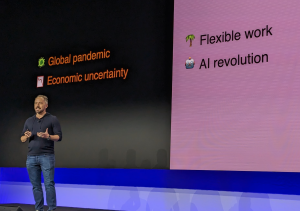
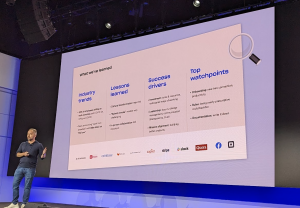
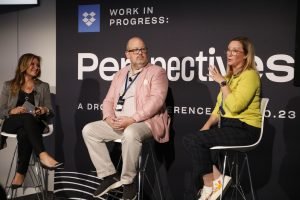
 As Alvin Toffler wrote over fifty years ago, “The illiterate of the 21st century will not be those who cannot read and write, but those who cannot learn, unlearn, and relearn.” The ever-quickening pace of change – and the necessity of adapting to that change – was a main theme of the New Directions in Scholarly Publishing Seminar, held October 4-5, 2023 and hosted by the
 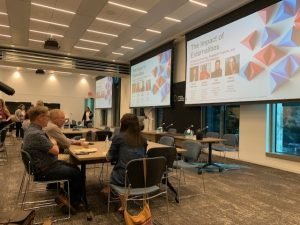 Discussions about artificial intelligence (AI) threaded through most of the presentations. Sessions such as “New Directions in Research Integrity: Values to Value in Research Publishing” and “Authorship in the Age of AI” emphasized embracing new technologies as tools without compromising one’s values or losing touch with the human elements that make scholarly publishing what it is. Dr. Rebecca Brendel, the Director of the Center for Bioethics at Harvard Medical School, delivered the keynote address, “New Directions in Research Integrity: Values to Value in Research and Publishing.” Dr. Brendel reminded all of us that integrity in research depends upon the integrity of individual researchers, administrators, and publishers. And, that core values such as honesty and transparency will be even more critical as AI continues to pervade the research and publication processes. Following the keynote address, Simone Taylor, the Publisher of the American Psychiatric Association, moderated a discussion with Dr. Brendel.