• Blog
  • Podcast
    • Publishing Fact or Fiction: Getting Ready for ADA Title II – Podcast
    • Westchester Words – All Episodes
  • WEBINARS
    • Publishing Now Fall ’24 webinar
    • Publishing Now Spring ’24 webinar
    • Publishing Now Fall ’23 webinar
    • Publishing Now Spring ’23 webinar
    • Publishing Now Fall ’22 webinar
    • Publishing Now Spring ’22 webinar
    • Publishing Now Fall ’21 webinar
    • Publishing Now Spring ’21 webinar
    • Publishing Now Summer ’20 webinar
  • About Us
    • Meet Our Team
    • Press
    • How Westchester Helps Publishers
    • Markets We Serve
    • Our Clients
    • Client Testimonials
    • Our Partner Network
    • Our Workflows
    • Conferences & Events
    • Publishers Weekly Special Report-Prepress Services
    • Careers
  • Contact Us
  • PORTAL LOGIN
  • Skip to main content
  • Skip to footer

Westchester Publishing Services

Excellence Delivered

  • Composition Services
    • Sustainable Typesetting®
    • U.S. Serviced Typesetting
    • Offshore Typesetting
    • LaTeX Typesetting
    • Pre-Edit Service
    • ePubs and Digital Conversion
    • Digitally Accessible Content Resources
  • Editorial Services
    • Domestic Editorial Project Management
    • Offshore Editorial Project Management
    • Art and Design
  • Client Portal
  • Westchester UK
    • Education – UK & International
    • Publishing – UK
  • Education Services

PCPA 2026 – An Energizing Experience

Conferences

May 8, 2026

by Tyler M. Carey, Chief Revenue Officer

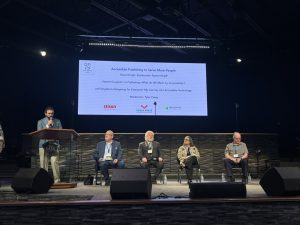
Conference panelists seated on the stage for session about accessibility in publishingAttending the PCPA 2026 conference on behalf of Westchester Publishing Services was an energizing and rewarding experience. From the opening plenary through the closing sessions, the event delivered thoughtful, practical content that spoke directly to the opportunities and challenges facing publishers today. 
One of the biggest takeaways was the strength of the programming. The keynote sessions offered a solid mix of strategy, innovation, and real-world application, especially around artificial intelligence, accessibility, and discoverability. I was especially glad to take part in the accessibility panel, where I had the opportunity to moderate a meaningful discussion on how publishers can better serve more people through inclusive content and technology. It was encouraging to see how much momentum there is around making publishing more accessible, sustainable, and audience-focused. 

The workshop lineup also reinforced just how much our industry is evolving. Sessions on AI tools for publishing operations, accessibility best practices, metadata, translation, and digital marketing all offered practical insights that attendees could take back to their organizations right away. The content was consistently strong, relevant, and well delivered, making it clear that this conference was designed to provide real value rather than just high-level talking points. 

Just as valuable as the sessions themselves was the opportunity to connect with so many partners, clients, and colleagues across the publishing community. Those conversations in the hallways, during networking breaks, and on the exhibit floor were a highlight of the event. It was a great chance to strengthen existing relationships, make new connections, and hear firsthand about the priorities and challenges others are navigating. 

We’re proud that Westchester Publishing Services was part of this year’s conference, and we left feeling inspired by both the quality of the content and the incredible people who make this industry so collaborative and forward-looking. 

Filed Under: blog, Conferences, News, Services

May 8, 2026

by Alli DeMan, Account Manager

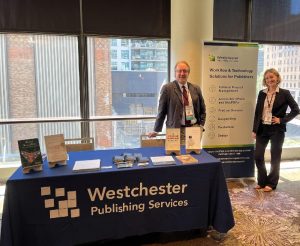
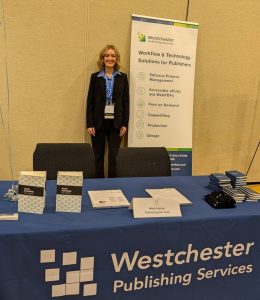
young woman with short blonde hair standing behind a conference table and next to a rollup banner.I recently attended PCPA (Protestant Church Publishers Association) 2026, and as possibly the youngest attendee of the conference, I found myself returning often to a central theme of how publishers can better understand and reach people in my age group.
During formal sessions, in side conversations, and in the broader atmosphere of the conference, it was acknowledged that this generation is searching for community, connection, and belonging, with many of us finding this through religion.

Our life is shaped by technology, which may explain why we are drawn to religious spaces. For faith-based publishers who want to reach members of Gen Z, it helps to understand that many readers in this age group engage with religion differently than previous generations. There is strong interest in doctrine as well as the spiritual, philosophical, and exploratory dimensions of faith. Books examining these questions thoughtfully and openly, or that connect religion to culture, art, music, and everyday life, may resonate more strongly with younger adults.

I was particularly struck by the perspectives of Keith Reigert, Fauzia Burke, and Valarie Guagnini, who helped frame these concepts within the larger work of publishing during separate sessions at the conference.

The keynote “Practical AI for Publishers”, included Keith, founder of Stable Book Group, who I first heard at a session he presented about AI during the NYU Summer Publishing Institute program. It was both intriguing and thought provoking to hear how leaders in the industry think about AI, with opinions ranging from a human-focused AI model to more technology forward thinking. As people become more reliant on AI for what they write, think, and feel, I believe the publishing industry needs to promote these conversations. It was great to reconnect with Keith at PCPA and his excitement and passion for the future of the industry were infectious, leaving me inspired to embrace the future of technology.

My colleague, Tyler Carey, moderated the second keynote session “Accessible Publishing to Serve More People”. Valarie Guagnini, Cambridge University’s Head of Equity, Diversity, Inclusion & Belonging, was one of the panelists, and she brings a unique perspective to the topics of accessibility, faith, and human-first based AI thought.  During the discussion, she shared that accessibility shouldn’t be viewed as a checklist of tasks to complete, but as an opportunity to love thy neighbor. This resonated strongly with me and I’m sure with many of the other attendees.

A few weeks prior to the conference I also participated in a webinar hosted by PCPA, “How Christian Publishers Can Reach Gen Z”, which discussed some of the ideas that were further expanded on during the conference. That consistency stood out to me, with the same underlying message being shared across both the webinar and the conference: Publishers who want to connect with Gen Z need to do so with nuance and authenticity. For me, the takeaway from PCPA was not that publishers need to chase trends, but that they need to better understand a generation who are asking serious questions about identity, meaning, creativity, and belonging.

Filed Under: blog, Conferences

March 18, 2026

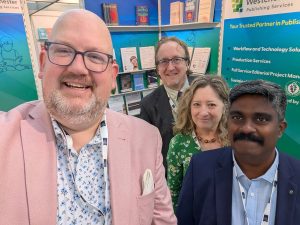
A group of colleagues standing inside a trade show booth for Westchester Publishing Services and Westchester EducationThe Westchester team – with representation from our offices in the US, UK, and India – had a very busy London Book Fair. The Olympia, for all of its pros and cons, has been a hub for our industry for over a decade, and it will be a culture shock to shift to the Excel next year. (For a look back on that, please check out this LinkedIn post.)

Publishers Weekly and The Bookseller did fantastic jobs with their coverage of the Fair. Key topics that the attendees were discussing were AI (for and against), accessibility (with a phenomenal session moderated by Simon Mellins including publishing experts like Princeton University Press’ Cathy Felgar), print on demand, and global disruptions to our industry. The above linked articles do a good job showing what was being discussed in panels and on the floor, and I encourage you to check out their coverage.

For this final year at Olympia, what was on publishers’ minds? We met with over 60 publishers and these were the top topics:

  • Accessibility – While many publishers may feel they’ve heard it all about accessibility at this point, the adoption of ADA Title II, and its expected impact on library acquisitions in the US provided an opportunity to reaffirm workflow decisions, talk about their backlists and what they may wish to do to ensure futureproofing their files, including the potential AI offers to address alt text and language shift tagging needs.
  • AI – As a recent PwC commercial represented, it sure does feel like everybody’s trying to wedge ‘AI’ into their product descriptions and solutions the way everyone said ‘blockchain’ about 8 years ago or ‘AR/VR’ about 10 years ago. That being said, one publisher caught some flak for saying that AI is a worker skill that we can’t ignore (see PW article above), and they’re not wrong. As an industry we have every right to be concerned about AI due to the lawsuits against Gen AI platforms that enthusiastically abused publishers’ intellectual property. But, learning and – where appropriate – putting into practice AI skills in the workplace will be our industry’s competitive gap as compared to other media verticals like recording, film, and journalism that have in some cases advanced the use of non-content-led AI within their workplace. Comparing documents from business partners, answering questions (with attribution) regarding complex topics, doing market analysis, and more are business needs that any business has. Our discussions around AI have emphasized that Westchester is not using AI on client content with the exception of cases where clients want us to use it – and have signed contracts to do so – to support tasks like crafting alt text. This PW interview with our CEO, Deb Taylor, talks about how AI can be powerful when used with appropriate consent and human review, but not as a catch all to all problems or needs. Our discussions with clients and prospects seemed to echo this – a cautious enthusiasm but the need to have trust, transparency, and a human in the loop. I’m very curious to see how the industry has progressed on this topic by the time of next year’s London Book Fair.
  • Speed to Market – Driven by our ability to help publishers like Zando and Sourcebooks edit and typeset their pick ups and key titles quickly, we saw a number of publishers identifying use cases where upcoming books may only have weeks instead of months to move from the copyediting stage to printer files. Several of our discussions focused on the specialized workflows Westchester has developed to help move important titles on your list into the market quickly.
  • Sustainability – Likely driven by our launch of Sustainable Typesetting® – in partnership with 2K/Denmark – we had many discussions about how we can help publishers take extra-long titles and reduce the page count by 20%, meaning less paper required for printing, less weight for freight, and other practical savings across a book’s life cycle, while also supporting the sustainability initiatives many of our clients are pursuing.
  • Journal Programs – Increasingly, our society and university press clients are acquiring journals that need varying levels of support, from as far upstream as peer review through to our copyediting and production offerings and then to digital distribution, sales, and more. We’ll be announcing a new set of services at the Council of Science Editors (CSE) conference in a few weeks, but if you are publishing journals and need to evaluate different service levels or needs, please reach out.
  • Repurposing Backlist Content – This was especially interesting to our education clients. Many educational content providers – especially those serving the library market – see topical opportunities arise for state adoption, general interest library sales, and more, but acquiring or packaging new titles to support those needs can be cost prohibitive depending on the market opportunity. Never fear, Westchester has a great, cost-effective solution. We are increasingly helping our educational partners take backlist titles – in some cases deep backlist titles – and updating them as new editions with new covers, updated interior text, new art, and more, all resulting in quick-to-market printer files and accessible EPUBs. This approach generated a great deal of interest from our partners, as a way to support expanding their lists without the large expenditure.
  • How to Get it All Done – Lastly, for many of the publishers we met, they are trying to get more books done without raising headcount. Seasonal spikes don’t always translate to continued productivity throughout the year, so many of our discussions revolved around how we can help publishers manage those peaks by providing project management, copyediting, design, production, and accessible digital services for titles where adding staff is difficult to justify. We work with many publishers where we augment their capacity during busy seasons, and are open to exploring these kinds of solutions with you, using staff from our US, UK, and India offices, based on a book’s needs and budget.

Which of the above topics are affecting you the most? Contact Us to discuss how we can help. And we’ll see you on the conference circuit this year at PCPA, CSE, AUP, and more!

Filed Under: blog, Conferences, News, Services Tagged With: accessibility, AI, backlist titles, journals, print on demand, repurposing content, speed to market, sustainability, workload

May 22, 2025

On Wednesday, May 21, Westchester Publishing Services sponsored the IPG Summer Summit virtual event. The day featured several sessions covering tariffs, metadata, marketing, and accessibility. A full day, indeed!

Westchester’s Chief Revenue Officer Tyler Carey moderated the panel on accessibility, which featured panelists Julie Willis (Editorial Director and Systems Lead from Westchester, speaking on behalf of an absent client), Eileen Reilly (Digital Production Manager at Princeton University Press), and Michael Johnson (Vice President of Content from Benetech).

The IPG will be sharing the slides and video shortly, and we’ll update this blog post with those assets once they are available. But in the interim, here are the key topics that were covered:

  • The EAA deadline is approaching fast – June 28, 2025!
  • Julie and Eileen talked about the steps that two IPG-member presses are taking to prepare, including:
    • Evaluating all of the titles in your backlist in your ONIX feed and sales data, with a consideration towards remediation costs in mind. Titles that have high sales volume are being remediated first, but documenting decisions and future plans by title is also important. If a title is challenged for inaccessibility, being able to provide documentation regarding the accessibility plan for that title is a strategy that some publishers are taking to minimise risk.
    • Setting up author guidelines for the creation of alt text – like these ones on Princeton University Press’ site – is a key step to bringing accessibility into the process early on a frontlist title, and giving authors agency to write or influence the alt text of their content. Julie talked about the importance of this – especially on academic titles that go through peer review – as the author holds responsibility for the content in many cases.
    • Joining PAAG, DAISY, and Benetech’s GCA program, so that you have access to up-to-date information on accessibility practices and legislation.
  • Michael shared Benetech’s approach to accessibility, and answered questions on topics including:
    • Alt text – Michael shared guidance on the different needs for different use cases for an image. An image of the Eiffel Tower in a cookbook on crêpes might be decorative, and could be labelled as such. In a travel guide for Paris the same image might merit a description of the Eiffel Tower for a reader having the text read aloud to them. For a book on engineering, the same image might bear an alt text entry about its construction from iron instead of steel, augmenting what is in the text through a description of the Eiffel Tower’s structure itself.
    • Language shift tagging – this topic has been coming up more and more often for publishers exploring the requirements for WCAG AA standards, as they try to get ahead of the baseline level A standards inferred to be required for the EAA. Michael talked to how casual use terms and place names do not need to be tagged, but passages and alternating dialogue in different languages, as examples, should be tagged.
  • Lastly, best practices to really understand and embrace accessibility were discussed, including the recommendation to download Thorium or another accessible reading software, so that you can have your EPUB files read aloud to you to better understand the end user’s experience. Between this process and auditing ACE by DAISY reports on your titles, you will be better equipped to have quality accessible EPUB files that don’t just meet standards but also address the needs of end users.

Stay tuned for more accessibility information from Westchester, and please do visit our online repository of accessibility information, including this white paper.

Filed Under: blog, Conferences, Services Tagged With: accessibility, alt text, DAISY, EAA, European Accessibility Act, IPG, language shift tagging, PAAG, WCAG

March 28, 2025

Observations from the London Book Fair 2025

Six business professionals standing in the Westchester Publishing Services booth during the London Book Fair 2025.
Pictured from l to r: Dennis Pistone, Deb Taylor, Julie Willis, Rebecca Durose-Croft, Christober Masilamani, and Tyler M. Carey

Authors and AI were ruling the world at this year’s London Book Fair. Westchester assembled members of our team from our US, UK, and India locations – our largest team yet – to visit with our clients at the Fair, including Deb Taylor (President), Dennis Pistone (Chairman), Rebecca Durose-Croft (Managing Director, Westchester UK), Christober Masilamani (Managing Director, India), Julie Willis (Editorial Director), and myself. Visit the Meet Our Team page to learn more.

With over 40 meetings spread across the three days of the Fair, it was the ideal venue to meet with so many of our clients, partners, and prospects, to discuss the things that are affecting their businesses and their publications programs. Below is a brief overview, in the hopes that there are a few topics you will find merit some further discussion. If you’re interested in speaking with us about any of the items below or other concerns related to your publications program, we’d love to hear from you!

Rights

o The Rights Hall upstairs at Olympia was doing a brisk business, with authors meeting with publishers to sell rights to their publications, global rights, and an increasing focus on media rights for streaming platforms and studios.
o Authors seemed to be in more of a power position than in recent years, with the rise of self-publishing – like IngramSpark’s platform, which Westchester supports via editorial and production offerings – serving as proof of concept for more publishers than this model had done in the past.

Technology

o AI of course was inescapable. Most manufacturing vendors had some sort of service or widget to enable AI to create efficiency for themselves or their clients. That said, over the course of our dozens of meetings it was evident there remains apprehensiveness from publishers about generative AI getting a hold of their content before it is released to market or scraping it to train models.

o Westchester continues to be thoughtful about how we approach AI, requiring a request and consent from a client before any AI tools would be used for any portions of their workflow, whether it be for generating keywords and metadata, over time the ability to craft alt text using AI, or other requirements. We would like to better understand your organization’s plans regarding AI, and any policies we should keep in mind while exploring any tools to support your needs. If you have a couple of minutes, please share your thoughts, using this short, confidential survey.

o Of all the AI platforms on offer at the Fair, the one that seems to continue to generate the most buzz is shimmr.ai, a platform for online advertising leveraging AI. Their stand party, and discussions throughout the Fair, pointed to their platform as one that is gaining momentum.

o The Fair also served as an opportunity for us to connect in person with thought leaders whom we respect and trust, including George Walkley of Outside Context (sample article on his thoughts on AI) who is leading training for the industry on use cases for AI and providing education via his relationship with the Independent Publishers Guild, and Stable Book Group President and PerfectBound.io CEO Keith Riegert, whom you may know from past Westchester and PW webinar content. Keith regularly speaks on AI, and provides some very practical advice for publishers in this post on the perfectbound.io site.

Document holder containing information about creating accessible reading materials.Accessibility

o Whether publishers are in trade, academic, education, the policy group space, or any other area of publishing, the topic of the European Accessibility Act, and its late June enforcement date reigned supreme throughout many of our discussions. As a DAISY partner and Benetech GCA-certified vendor, we found ourselves in the position of helping many of our clients and prospects evaluate specific action plans for moving forward with remediating their backlist and adjusting their frontlist workflows to better involve authors in the creation or approval of alt text. Our white paper, recently released in partnership with consultant Laura Brady and Typeflow CEO Keith Snyder, provides some further advice to consider on this topic, and you can learn more about accessibility on our resources page.

Capacity

o Many of our clients rely on Westchester as a trusted, strategic partner, tapping into our more than 55 years of operational knowledge serving publishers of all sizes and content offerings. We consult with them as they navigate the best way to grow their lists, increase speed to market, and mitigate risk factors impacting our industries. Few publishers are having those existential leaps about wholly outsourcing their lists these days, which speaks to how well many publishers are staffing to their core business.

Publishers often come to us seeking help with defining workflows where we can take on tasks beyond what an in-house team has the bandwidth to handle. If your in-house production editors or production staff – whose responsibilities may also include paying freelancer invoices, brokering print runs, ensuring files are shipped to warehouses, etc. – can work on XX titles per year, how many books could you publish? With added support from a vendor like Westchester would you be able to complete 20 more books a year? 50? 100? This question was at the core of the conversations we had across market sectors during the Fair – and something we would welcome exploring with you.

Please Contact Us to arrange a conversation about any of the above topics that have relevance for you, or ways Westchester can help you get your books to market more quickly and with the quality your readers deserve.

Filed Under: blog, Conferences, News, Services

  • Page 1
  • Page 2
  • Page 3
  • Interim pages omitted …
  • Page 10
  • Go to Next Page »

Footer

We’re ready to help you!     Contact Us   Call +1 203-658-6581

About Us  |  Conferences  |  Press  |  Blog |  Careers  | Privacy Policy |  Education Services  |  Westchester UK
  • Email
  • LinkedIn
  • YouTube

Copyright © 2026 Westchester Publishing Services, LLC.

This website uses cookies to analyze traffic, improve your visit and to help us communicate more effectively with you. Our privacy policy has new information.   Accept Read Privacy Policy
Privacy & Cookies Policy

Privacy Overview

This website uses cookies to improve your experience while you navigate through the website. Out of these, the cookies that are categorized as necessary are stored on your browser as they are essential for the working of basic functionalities of the website. We also use third-party cookies that help us analyze and understand how you use this website. These cookies will be stored in your browser only with your consent. You also have the option to opt-out of these cookies. But opting out of some of these cookies may affect your browsing experience.
Necessary
Always Enabled
Necessary cookies are absolutely essential for the website to function properly. This category only includes cookies that ensures basic functionalities and security features of the website. These cookies do not store any personal information.
Non-necessary
Any cookies that may not be particularly necessary for the website to function and is used specifically to collect user personal data via analytics, ads, other embedded contents are termed as non-necessary cookies. It is mandatory to procure user consent prior to running these cookies on your website.
SAVE & ACCEPT