• Blog
  • Podcast
    • Starting the Accessible Publishing Journey – Podcast
    • Westchester Words – All Episodes
  • WEBINARS
    • Publishing Now Fall ’24 webinar
    • Publishing Now Spring ’24 webinar
    • Publishing Now Fall ’23 webinar
    • Publishing Now Spring ’23 webinar
    • Publishing Now Fall ’22 webinar
    • Publishing Now Spring ’22 webinar
    • Publishing Now Fall ’21 webinar
    • Publishing Now Spring ’21 webinar
    • Publishing Now Summer ’20 webinar
  • About Us
    • Meet Our Team
    • Press
    • How Westchester Helps Publishers
    • Markets We Serve
    • Our Clients
    • Client Testimonials
    • Our Partner Network
    • Our Workflows
    • Conferences & Events
    • Publishers Weekly Special Report-Prepress Services
    • Careers
  • Contact Us
  • PORTAL LOGIN
  • Skip to main content
  • Skip to footer

Westchester Publishing Services

Excellence Delivered

  • Composition Services
    • Sustainable Typesetting®
    • U.S. Serviced Typesetting
    • Offshore Typesetting
    • LaTeX Typesetting
    • Pre-Edit Service
    • ePubs and Digital Conversion
    • European Accessibility Act (EAA) Information
  • Editorial Services
    • Domestic Editorial Project Management
    • Offshore Editorial Project Management
    • Art and Design
  • Client Portal
  • Westchester UK
    • Education – UK & International
    • Publishing – UK
  • Education Services

Travels with Tyler (and Dan), IPG Autumn Conference, September 2025

Services

September 23, 2025

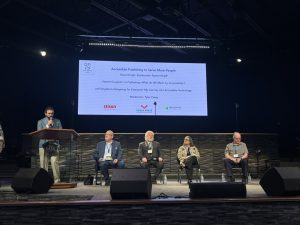
IPG conference banner for September 16, 2025, with Westchester logo in lower right hand cornerAs always, the Independent Publishers Guild (IPG) put on a stellar Autumn Conference at the Shaw Theatre in London, on Tuesday, September 16. Westchester staff Dan Verdick (Director, Client Solutions) and Tyler M. Carey (Chief Revenue Officer) represented us at the conference. Tyler also moderated a panel on accessibility – “Publishers’ Journeys in Accessibility” which featured speakers Achim Bosse Chitty, Divisional Head of Production at Bloomsbury Publishing, Megan Taylor, Partnerships Manager from Boydell & Brewer, James Woollam, Managing Director of David & Charles Publishing, and digital publishing consultant, Simon Mellins.

At the end of this post, we provide links to articles with soup to nuts coverage of the event. Here are several important observations from Dan and Tyler’s feet-on-the-ground vantage point:

Tyler shared, “Publishers seemed to be carrying more stress and concern at this event than we saw at London Book Fair and some of the intervening summer get togethers across the markets we serve. There was an emphasis on managing costs in many of our discussions with prospective partners and clients. A potential pathway to achieve this is through the use of AI, where the client’s IP is protected in walled gardens and the use cases are repeatable and consistent. One publisher, for instance, was very curious to discuss use cases Westchester has for AI on alt text and other compliance requirements for accessibility – but they volunteered they were less comfortable with the idea of using AI for copyediting, proofreading, and anything where language and style may need to be more rigorous across a larger piece of content than how a brief alt text entry is crafted. Dan and I also chatted with several publishers who were exceptionally bullish on using AI throughout their operation – with content as well as routinized tasks that they see as having high potential to be automated through AI. The hope for some publishers in the latter group is that they can leverage AI as a tool to help manage the headwinds of increased manufacturing costs while also maintaining current staffing levels and growing their current list sizes.”

podium with a microphone and banner for IPG behind it. To left of podium a man in a blue pullover and blue blazer is speaking and holding a half-full glass of water in his right hand.Dan’s conversations with our clients and prospects opened up a lot of dialogue about EPUB accessibility. “Westchester’s hosting the panel on accessibility drove booth traffic and dialogue about our processes for remediating and converting ePubs. As a Benetech GCA-certified vendor, we are externally audited each year to ensure we’re providing as high a level of quality and service in creating accessible EPUB files as possible. Discussions about alt text, language shift tagging, and speed of conversion and remediation were plentiful, as well as our ability to scale up for larger batches of titles to be made accessible. I give a lot of credit to our panelists for being transparent about their successes and struggles on this front, and for the ongoing discussions about making sure there’s a plan for key backlist and more.”

The “Make GEO Work for You” session offered a fascinating discussion of Generative Engine Optimisation, the latest buzz-worthy acronym for discoverability and content management in the AI-driven “next Internet,” where bots crawl the Web looking for vulnerable content they can scrape, and where Web visitors and clicks may be bots, too. Lead by George Walkley, the session’s panel debated the balance between gatekeeping content vs. having enough content for AI and search engines to find and learn more for a human searcher’s needs, and other aspects of content in a GEO online space. “Auditing your content’s digital footprint and further steps were discussed,” Dan added. “And for journals publishers, there was also extensive discussion of the risks for content that is available for AI-driven engines and what subscribers may be accessing as well.” To learn more about AI and GEO, George is a panelist for BISG’s September 30 webinar, “AI and Ethics in the Book Industry” which will discuss frameworks, strategies, and real-world lessons on navigating AI’s promise and its pitfalls.

A group of four people standing on a brick sidewalk outside a building in London.
l to r: Dan Verdick, Rebecca Durose-Croft, Emma Hudson, Tyler M. Carey

In addition to the trade and academic publishing discussions which took place at IPG, Westchester’s UK-based education team, Managing Director Rebecca Durose-Croft and Content Director Emma Hudson, joined Dan and Tyler to visit key edtech and education publishing customers in the UK to discuss the latest trends in these spaces. “Helping publishers deal with any and all changes in today’s world, from CEID reviews of content for today’s learners, to changing format needs for online content, were part of our customer discussions,” Dan added. “Our team discussed a range of needs UK publishers have in markets they serve around the world, and how adapting to the almost daily changes in educational publishing are vital to success and growth during what is an uncertain time in some education markets.”

For more coverage about the IPG Autumn Conference and session content, you can read this article in The Bookseller and several posts from Bookbrunch, including this article (login or subscription may be required to both sites). The IPG did a phenomenal job bringing the British publishing industry together to talk about the pressures on small and mid-sized publishers, opportunities for addressing those challenges, and providing excellent professional development for everyone attending. We’re looking forward to seeing our friends and colleagues at the next IPG event.

As your plans take shape with your 2026 lists, talk with us about solutions we provide to make your workflow more effective and increase speed to market for your titles.

Filed Under: blog, Conferences, Services, Westchester UK News

May 22, 2025

On Wednesday, May 21, Westchester Publishing Services sponsored the IPG Summer Summit virtual event. The day featured several sessions covering tariffs, metadata, marketing, and accessibility. A full day, indeed!

Westchester’s Chief Revenue Officer Tyler Carey moderated the panel on accessibility, which featured panelists Julie Willis (Editorial Director and Systems Lead from Westchester, speaking on behalf of an absent client), Eileen Reilly (Digital Production Manager at Princeton University Press), and Michael Johnson (Vice President of Content from Benetech).

The IPG will be sharing the slides and video shortly, and we’ll update this blog post with those assets once they are available. But in the interim, here are the key topics that were covered:

  • The EAA deadline is approaching fast – June 28, 2025!
  • Julie and Eileen talked about the steps that two IPG-member presses are taking to prepare, including:
    • Evaluating all of the titles in your backlist in your ONIX feed and sales data, with a consideration towards remediation costs in mind. Titles that have high sales volume are being remediated first, but documenting decisions and future plans by title is also important. If a title is challenged for inaccessibility, being able to provide documentation regarding the accessibility plan for that title is a strategy that some publishers are taking to minimise risk.
    • Setting up author guidelines for the creation of alt text – like these ones on Princeton University Press’ site – is a key step to bringing accessibility into the process early on a frontlist title, and giving authors agency to write or influence the alt text of their content. Julie talked about the importance of this – especially on academic titles that go through peer review – as the author holds responsibility for the content in many cases.
    • Joining PAAG, DAISY, and Benetech’s GCA program, so that you have access to up-to-date information on accessibility practices and legislation.
  • Michael shared Benetech’s approach to accessibility, and answered questions on topics including:
    • Alt text – Michael shared guidance on the different needs for different use cases for an image. An image of the Eiffel Tower in a cookbook on crêpes might be decorative, and could be labelled as such. In a travel guide for Paris the same image might merit a description of the Eiffel Tower for a reader having the text read aloud to them. For a book on engineering, the same image might bear an alt text entry about its construction from iron instead of steel, augmenting what is in the text through a description of the Eiffel Tower’s structure itself.
    • Language shift tagging – this topic has been coming up more and more often for publishers exploring the requirements for WCAG AA standards, as they try to get ahead of the baseline level A standards inferred to be required for the EAA. Michael talked to how casual use terms and place names do not need to be tagged, but passages and alternating dialogue in different languages, as examples, should be tagged.
  • Lastly, best practices to really understand and embrace accessibility were discussed, including the recommendation to download Thorium or another accessible reading software, so that you can have your EPUB files read aloud to you to better understand the end user’s experience. Between this process and auditing ACE by DAISY reports on your titles, you will be better equipped to have quality accessible EPUB files that don’t just meet standards but also address the needs of end users.

Stay tuned for more accessibility information from Westchester, and please do visit our online repository of accessibility information, including this white paper.

Filed Under: blog, Conferences, Services Tagged With: accessibility, alt text, DAISY, EAA, European Accessibility Act, IPG, language shift tagging, PAAG, WCAG

April 30, 2025

What a year, right? With the approach of the EAA, decisions publishers are making about WCAG compliance, Title II, and Amazon changing its deliverable epub formats (again), the Westchester staff have been hearing quite a lot from our clients. To help address our clients’ questions, and also share information more widely, we put together this brief blog post about some key topics related to digital content and workflows, to help share our perspective and institutional knowledge.

Language Tagging Manuscripts

The goal of language tagging is to ensure that assistive technology can correctly interpret phrases, passages, and certain individual words presented in other than the document’s primary language. It is a requirement for meeting WCAG 2.x Level AA. It is worth noting, at this point the EAA does not explicitly require WCAG 2.x Level AA, but some publishers are more actively pursuing this higher level of standard to stay ahead of the game in case clarifications or new requirements force this requirement over time.

Language tagging is not necessarily needed on every publication. The stated exclusions to this rule are “proper names, technical terms, words of indeterminate language, and words or phrases that have become part of the vernacular.”

The proper names exclusion is taken to apply to “people, places, organizations” (and the like) per CMOS Shoptalk, the Random House Guide to Good Writing (Ivers 1991, which specifically adds “churches, streets”), and DAISY (which helpfully renders this simply as “names”). Titles of works are not part of this exclusion; see, for instance, the article “Declaring language in HTML” where the W3C uses a book title for their example. Technical Terms This exclusion applies to terms which have a technical meaning across languages. WCAG gives the examples of Homo sapiens, Alpha Centauri, hertz, and habeas corpus. In practice, especially within academic publishing and if the tagging is handled by a non-specialist, such terms can be harder to identify. Generally, any jargon falls into this category, but an understanding of the intended audience may also factor into whether to tag or not. Indeterminate Language Gibberish and most constructed languages belong to this category, but Esperanto has an ISO language code, as do Tolkien’s Elvish languages of Quenya and Sindarin, and Star Trek’s Klingon, so all those can be tagged. Part of the Vernacular Foreign words or phrases that find themselves in the English dictionary (to take this from the English perspective) may be excluded from tagging. WCAG gives “rendezvous” as an example. A perhaps better example would be “sine qua non.” If the text in question is italicized, and it’s not to show emphasis or to state the word as a word, that may be a good indication that it should be tagged. WCAG advises, “If there is doubt whether a change in language is intended, consider whether the word would be pronounced the same (except for accent or intonation) in the language of the immediately surrounding text.”

Amazon no longer supporting MOBI Fixed Layout files

As of March 18, 2025, Amazon no longer supports MOBI fixed-layout files. This is similar to when Amazon stopped supporting MOBI files for reflowable books on August 1, 2021. One difference is that besides EPUB, there is an alternate Amazon-specific format which may be more appropriate for some content, Kindle Package Format (KPF). If you are an Ingram CoreSource customer, they are setup to accept this format, and so digital asset management on their platform will be a seamless transition from FXL MOBI to FXL KPF. If you already have content posted to Amazon in the older format, you are not required to update it for it to remain on sale. But if you do update an existing file (e.g. to handle reprint corrections, replace back ads, etc.) you will be required to upload the new file in the KPF format.

Metadata

Rich accessibility metadata in EPUB and ONIX goes beyond ticking a standards box. It actively improves discovery and usability for readers, unlocks new markets, aids institutional buyers (libraries/education), and bolsters a publisher’s social responsibility image. Accessibility metadata within EPUBs makes them self-descriptive about their accessible features, helping users and systems find suitable titles. ONIX metadata allows distributors to “present this information to potential purchasers and readers” ahead of time, so they can make informed choices. Industry groups like DAISY and Accessible Publishing Learning Network (APLN) provide guidance on how to implement this metadata (see DAISY’s Inclusive Publishing “Metadata” page, which provided the preceding quote, and APLN’s “Accessibility Metadata Best Practices for Ebooks”), so that every accessible feature is documented and visible and may benefit users and publishers alike.

To comply with the EAA, metadata should be provided for the relevant accessibility items, particularly those from Codelist 196 and Codelist 143, though other metadata may apply as well (e.g., Codelist 81).

Whatever database or title management system you use to manage your metadata should have fields that correspond to the ONIX codes.

If you’re unsure of which accessibility features are included in your EPUB, you may get most of those details from an Ace report.

Probably the best resource (with explanations and examples of both EPUB and ONIX metadata) is the DAISY Accessible Publishing Knowledge Base metadata page. It still requires some technical understanding though.

The accessibility metadata in a typical EPUB for a non-fiction book with images, and which has been produced with the intent to be accessible, would look something like the following:

<meta property=”schema:accessibilityFeature”>ARIA</meta>
<meta property=”schema:accessibilityFeature”>displayTransformability</meta>
<meta property=”schema:accessibilityFeature”>pageBreakMarkers</meta>
<meta property=”schema:accessibilityFeature”>pageNavigation</meta>
<meta property=”schema:accessibilityFeature”>readingOrder</meta>
<meta property=”schema:accessibilityFeature”>structuralNavigation</meta>
<meta property=”schema:accessibilityFeature”>tableOfContents</meta>
<meta property=”schema:accessibilityFeature”>index</meta>
<meta property=”schema:accessibilityFeature”>alternativeText</meta>
<meta property=”schema:accessMode”>textual</meta>
<meta property=”schema:accessMode”>visual</meta>
<meta property=”schema:accessModeSufficient”>textual,visual</meta>
<meta property=”schema:accessModeSufficient”>textual</meta>
<meta property=”schema:accessibilityHazard”>none</meta>

This is not an exhaustive list. Other features may be present (MathML or long descriptions, for example), conformance level may be identified, and a summary (no longer required) should be included with other relevant info, especially if any shortcomings. And these accessibility metadata items are of course to be included in addition to standard metadata such title, author, and source ISBN.

One important note is that the accessibility summary for ONIX does not have the same guidelines as the summary for EPUB. So, while mapping to ONIX based on the Ace report generally works well, it is not necessarily advisable to copy that for the ONIX summary.

The Westchester team has the expertise you can rely on to make sense of the updated standards and guide you through changes you may need to make to your content to ensure it remains accessible and discoverable for your readers. Contact us to learn how we can help your publication program.

Filed Under: blog, Featured, News, Services Tagged With: accessibility, discoverability, EAA, epub, European Accessibility Act, inclusive publishing, language tagging, metadata, ONIX, Title II, WCAG

March 28, 2025

Observations from the London Book Fair 2025

Six business professionals standing in the Westchester Publishing Services booth during the London Book Fair 2025.
Pictured from l to r: Dennis Pistone, Deb Taylor, Julie Willis, Rebecca Durose-Croft, Christober Masilamani, and Tyler M. Carey

Authors and AI were ruling the world at this year’s London Book Fair. Westchester assembled members of our team from our US, UK, and India locations – our largest team yet – to visit with our clients at the Fair, including Deb Taylor (President), Dennis Pistone (Chairman), Rebecca Durose-Croft (Managing Director, Westchester UK), Christober Masilamani (Managing Director, India), Julie Willis (Editorial Director), and myself. Visit the Meet Our Team page to learn more.

With over 40 meetings spread across the three days of the Fair, it was the ideal venue to meet with so many of our clients, partners, and prospects, to discuss the things that are affecting their businesses and their publications programs. Below is a brief overview, in the hopes that there are a few topics you will find merit some further discussion. If you’re interested in speaking with us about any of the items below or other concerns related to your publications program, we’d love to hear from you!

Rights

o The Rights Hall upstairs at Olympia was doing a brisk business, with authors meeting with publishers to sell rights to their publications, global rights, and an increasing focus on media rights for streaming platforms and studios.
o Authors seemed to be in more of a power position than in recent years, with the rise of self-publishing – like IngramSpark’s platform, which Westchester supports via editorial and production offerings – serving as proof of concept for more publishers than this model had done in the past.

Technology

o AI of course was inescapable. Most manufacturing vendors had some sort of service or widget to enable AI to create efficiency for themselves or their clients. That said, over the course of our dozens of meetings it was evident there remains apprehensiveness from publishers about generative AI getting a hold of their content before it is released to market or scraping it to train models.

o Westchester continues to be thoughtful about how we approach AI, requiring a request and consent from a client before any AI tools would be used for any portions of their workflow, whether it be for generating keywords and metadata, over time the ability to craft alt text using AI, or other requirements. We would like to better understand your organization’s plans regarding AI, and any policies we should keep in mind while exploring any tools to support your needs. If you have a couple of minutes, please share your thoughts, using this short, confidential survey.

o Of all the AI platforms on offer at the Fair, the one that seems to continue to generate the most buzz is shimmr.ai, a platform for online advertising leveraging AI. Their stand party, and discussions throughout the Fair, pointed to their platform as one that is gaining momentum.

o The Fair also served as an opportunity for us to connect in person with thought leaders whom we respect and trust, including George Walkley of Outside Context (sample article on his thoughts on AI) who is leading training for the industry on use cases for AI and providing education via his relationship with the Independent Publishers Guild, and Stable Book Group President and PerfectBound.io CEO Keith Riegert, whom you may know from past Westchester and PW webinar content. Keith regularly speaks on AI, and provides some very practical advice for publishers in this post on the perfectbound.io site.

Document holder containing information about creating accessible reading materials.Accessibility

o Whether publishers are in trade, academic, education, the policy group space, or any other area of publishing, the topic of the European Accessibility Act, and its late June enforcement date reigned supreme throughout many of our discussions. As a DAISY partner and Benetech GCA-certified vendor, we found ourselves in the position of helping many of our clients and prospects evaluate specific action plans for moving forward with remediating their backlist and adjusting their frontlist workflows to better involve authors in the creation or approval of alt text. Our white paper, recently released in partnership with consultant Laura Brady and Typeflow CEO Keith Snyder, provides some further advice to consider on this topic, and you can learn more about accessibility on our resources page.

Capacity

o Many of our clients rely on Westchester as a trusted, strategic partner, tapping into our more than 55 years of operational knowledge serving publishers of all sizes and content offerings. We consult with them as they navigate the best way to grow their lists, increase speed to market, and mitigate risk factors impacting our industries. Few publishers are having those existential leaps about wholly outsourcing their lists these days, which speaks to how well many publishers are staffing to their core business.

Publishers often come to us seeking help with defining workflows where we can take on tasks beyond what an in-house team has the bandwidth to handle. If your in-house production editors or production staff – whose responsibilities may also include paying freelancer invoices, brokering print runs, ensuring files are shipped to warehouses, etc. – can work on XX titles per year, how many books could you publish? With added support from a vendor like Westchester would you be able to complete 20 more books a year? 50? 100? This question was at the core of the conversations we had across market sectors during the Fair – and something we would welcome exploring with you.

Please Contact Us to arrange a conversation about any of the above topics that have relevance for you, or ways Westchester can help you get your books to market more quickly and with the quality your readers deserve.

Filed Under: blog, Conferences, News, Services

January 24, 2025

smiling man in front of a window showing the lower Manhattan skylineOn January 15, 2025, I had the good fortune to attend the New York Book Forum’s President’s Night event, which Westchester Publishing Services helped sponsor. 

For those of you unfamiliar with New York Book Forum, it is in name a regional publishing industry organization, but attracts attendees from all over for their in-person and virtual events, with the audience including publishers, manufacturers, vendors, authors, agents, and more. This year’s President’s Night event was hosted by Scholastic, which provided meeting space and a generous meal in their corporate cafe for the night’s attendees.

Regional organizations like the New York Book Forum are critical to our organization. Westchester has participated in many other regional or industry-specific get togethers over the year, from Bookmachine’s get togethers in London to Society for Scholarly Publishing (SSP) regional events for academic publishers in DC and New York. Certainly the industry is the poorer for the absence of Bookbuilders of Boston, which did not resume programming after the pandemic. Their annual NEPCo awards allowed publishers and vendors to submit joint projects to help educate the industry on new workflow models, products, and more. With publishing friends of mine in the Boston area looking for work right now, the absence of Bookbuilders on industry networking is really difficult, which makes me grateful for the opportunities afforded by events like what New York Book Forum puts on about 10 times per year, to allow people to gather, network, and learn.

man seating in front of audience, with windows showing a backdrop of the New York City skyline behind him.Scholastic’s Irene Chan did an amazing job interviewing Dave McCree, CEO of Lakeside Book Company about the trends he and his colleagues are seeing in the industry. For those of us in production and manufacturing, conversations like this are riveting, but Irene and Dave did a good job making the discussion accessible and entertaining for everyone in the audience.  A big portion of their discussion revolved around the practicalities of printing schedules and capacity.  There are an enormous amount of titles being printed these days, and each of those projects has to compete for windows of production time, no matter how few or how many copies are being printed. But when factors like the rising trends for deluxe editions requiring foils, stamps, or the ever present edge dyeing are added to the mix, that’s creating competition not just for printing windows but also for specific machinery needed to handle tasks like edge dyeing. Dave shared a lot of solid information about how to work with your production department, your vendors, and your printers to try to preplan and make the initial print runs – as well as reprints – go smoothly.

hallway in Scholastic headquarters featuring wall-sized mural for Clifford the Big Red Dog.Upcoming New York Book Forum events include a virtual event – accessible to us all – about Romance titles. Stay tuned for further learning and professional development events on the New York Book Forum calendar.

Westchester welcomes any input you have about what you are doing to customize your titles, and any ways we can help you manage your production schedules. Contact us to discuss your publications program, today.

Filed Under: blog, News, Services

  • Page 1
  • Page 2
  • Page 3
  • Interim pages omitted …
  • Page 15
  • Go to Next Page »

Footer

We’re ready to help you!     Contact Us   Call +1 203-658-6581

About Us  |  Conferences  |  Press  |  Blog |  Careers  | Privacy Policy |  Education Services  |  Westchester UK
  • Email
  • LinkedIn
  • YouTube

Copyright © 2025 Westchester Publishing Services, LLC.

This website uses cookies to analyze traffic, improve your visit and to help us communicate more effectively with you. Our privacy policy has new information.   Accept Read Privacy Policy
Privacy & Cookies Policy

Privacy Overview

This website uses cookies to improve your experience while you navigate through the website. Out of these, the cookies that are categorized as necessary are stored on your browser as they are essential for the working of basic functionalities of the website. We also use third-party cookies that help us analyze and understand how you use this website. These cookies will be stored in your browser only with your consent. You also have the option to opt-out of these cookies. But opting out of some of these cookies may affect your browsing experience.
Necessary
Always Enabled
Necessary cookies are absolutely essential for the website to function properly. This category only includes cookies that ensures basic functionalities and security features of the website. These cookies do not store any personal information.
Non-necessary
Any cookies that may not be particularly necessary for the website to function and is used specifically to collect user personal data via analytics, ads, other embedded contents are termed as non-necessary cookies. It is mandatory to procure user consent prior to running these cookies on your website.
SAVE & ACCEPT