• Blog
  • Podcast
    • Publishing Fact or Fiction: Getting Ready for ADA Title II – Podcast
    • Westchester Words – All Episodes
  • WEBINARS
    • Publishing Now Fall ’24 webinar
    • Publishing Now Spring ’24 webinar
    • Publishing Now Fall ’23 webinar
    • Publishing Now Spring ’23 webinar
    • Publishing Now Fall ’22 webinar
    • Publishing Now Spring ’22 webinar
    • Publishing Now Fall ’21 webinar
    • Publishing Now Spring ’21 webinar
    • Publishing Now Summer ’20 webinar
  • About Us
    • Meet Our Team
    • Press
    • How Westchester Helps Publishers
    • Markets We Serve
    • Our Clients
    • Client Testimonials
    • Our Partner Network
    • Our Workflows
    • Conferences & Events
    • Publishers Weekly Special Report-Prepress Services
    • Careers
  • Contact Us
  • PORTAL LOGIN
  • Skip to main content
  • Skip to footer

Westchester Publishing Services

Excellence Delivered

  • Composition Services
    • Sustainable Typesetting®
    • U.S. Serviced Typesetting
    • Offshore Typesetting
    • LaTeX Typesetting
    • Pre-Edit Service
    • ePubs and Digital Conversion
    • Digitally Accessible Content Resources
  • Editorial Services
    • Domestic Editorial Project Management
    • Offshore Editorial Project Management
    • Art and Design
  • Client Portal
  • Westchester UK
    • Education – UK & International
    • Publishing – UK
  • Education Services

London Book Fair 2026

accessibility

March 18, 2026

A group of colleagues standing inside a trade show booth for Westchester Publishing Services and Westchester EducationThe Westchester team – with representation from our offices in the US, UK, and India – had a very busy London Book Fair. The Olympia, for all of its pros and cons, has been a hub for our industry for over a decade, and it will be a culture shock to shift to the Excel next year. (For a look back on that, please check out this LinkedIn post.)

Publishers Weekly and The Bookseller did fantastic jobs with their coverage of the Fair. Key topics that the attendees were discussing were AI (for and against), accessibility (with a phenomenal session moderated by Simon Mellins including publishing experts like Princeton University Press’ Cathy Felgar), print on demand, and global disruptions to our industry. The above linked articles do a good job showing what was being discussed in panels and on the floor, and I encourage you to check out their coverage.

For this final year at Olympia, what was on publishers’ minds? We met with over 60 publishers and these were the top topics:

  • Accessibility – While many publishers may feel they’ve heard it all about accessibility at this point, the adoption of ADA Title II, and its expected impact on library acquisitions in the US provided an opportunity to reaffirm workflow decisions, talk about their backlists and what they may wish to do to ensure futureproofing their files, including the potential AI offers to address alt text and language shift tagging needs.
  • AI – As a recent PwC commercial represented, it sure does feel like everybody’s trying to wedge ‘AI’ into their product descriptions and solutions the way everyone said ‘blockchain’ about 8 years ago or ‘AR/VR’ about 10 years ago. That being said, one publisher caught some flak for saying that AI is a worker skill that we can’t ignore (see PW article above), and they’re not wrong. As an industry we have every right to be concerned about AI due to the lawsuits against Gen AI platforms that enthusiastically abused publishers’ intellectual property. But, learning and – where appropriate – putting into practice AI skills in the workplace will be our industry’s competitive gap as compared to other media verticals like recording, film, and journalism that have in some cases advanced the use of non-content-led AI within their workplace. Comparing documents from business partners, answering questions (with attribution) regarding complex topics, doing market analysis, and more are business needs that any business has. Our discussions around AI have emphasized that Westchester is not using AI on client content with the exception of cases where clients want us to use it – and have signed contracts to do so – to support tasks like crafting alt text. This PW interview with our CEO, Deb Taylor, talks about how AI can be powerful when used with appropriate consent and human review, but not as a catch all to all problems or needs. Our discussions with clients and prospects seemed to echo this – a cautious enthusiasm but the need to have trust, transparency, and a human in the loop. I’m very curious to see how the industry has progressed on this topic by the time of next year’s London Book Fair.
  • Speed to Market – Driven by our ability to help publishers like Zando and Sourcebooks edit and typeset their pick ups and key titles quickly, we saw a number of publishers identifying use cases where upcoming books may only have weeks instead of months to move from the copyediting stage to printer files. Several of our discussions focused on the specialized workflows Westchester has developed to help move important titles on your list into the market quickly.
  • Sustainability – Likely driven by our launch of Sustainable Typesetting® – in partnership with 2K/Denmark – we had many discussions about how we can help publishers take extra-long titles and reduce the page count by 20%, meaning less paper required for printing, less weight for freight, and other practical savings across a book’s life cycle, while also supporting the sustainability initiatives many of our clients are pursuing.
  • Journal Programs – Increasingly, our society and university press clients are acquiring journals that need varying levels of support, from as far upstream as peer review through to our copyediting and production offerings and then to digital distribution, sales, and more. We’ll be announcing a new set of services at the Council of Science Editors (CSE) conference in a few weeks, but if you are publishing journals and need to evaluate different service levels or needs, please reach out.
  • Repurposing Backlist Content – This was especially interesting to our education clients. Many educational content providers – especially those serving the library market – see topical opportunities arise for state adoption, general interest library sales, and more, but acquiring or packaging new titles to support those needs can be cost prohibitive depending on the market opportunity. Never fear, Westchester has a great, cost-effective solution. We are increasingly helping our educational partners take backlist titles – in some cases deep backlist titles – and updating them as new editions with new covers, updated interior text, new art, and more, all resulting in quick-to-market printer files and accessible EPUBs. This approach generated a great deal of interest from our partners, as a way to support expanding their lists without the large expenditure.
  • How to Get it All Done – Lastly, for many of the publishers we met, they are trying to get more books done without raising headcount. Seasonal spikes don’t always translate to continued productivity throughout the year, so many of our discussions revolved around how we can help publishers manage those peaks by providing project management, copyediting, design, production, and accessible digital services for titles where adding staff is difficult to justify. We work with many publishers where we augment their capacity during busy seasons, and are open to exploring these kinds of solutions with you, using staff from our US, UK, and India offices, based on a book’s needs and budget.

Which of the above topics are affecting you the most? Contact Us to discuss how we can help. And we’ll see you on the conference circuit this year at PCPA, CSE, AUP, and more!

Filed Under: blog, Conferences, News, Services Tagged With: accessibility, AI, backlist titles, journals, print on demand, repurposing content, speed to market, sustainability, workload

May 22, 2025

On Wednesday, May 21, Westchester Publishing Services sponsored the IPG Summer Summit virtual event. The day featured several sessions covering tariffs, metadata, marketing, and accessibility. A full day, indeed!

Westchester’s Chief Revenue Officer Tyler Carey moderated the panel on accessibility, which featured panelists Julie Willis (Editorial Director and Systems Lead from Westchester, speaking on behalf of an absent client), Eileen Reilly (Digital Production Manager at Princeton University Press), and Michael Johnson (Vice President of Content from Benetech).

The IPG will be sharing the slides and video shortly, and we’ll update this blog post with those assets once they are available. But in the interim, here are the key topics that were covered:

  • The EAA deadline is approaching fast – June 28, 2025!
  • Julie and Eileen talked about the steps that two IPG-member presses are taking to prepare, including:
    • Evaluating all of the titles in your backlist in your ONIX feed and sales data, with a consideration towards remediation costs in mind. Titles that have high sales volume are being remediated first, but documenting decisions and future plans by title is also important. If a title is challenged for inaccessibility, being able to provide documentation regarding the accessibility plan for that title is a strategy that some publishers are taking to minimise risk.
    • Setting up author guidelines for the creation of alt text – like these ones on Princeton University Press’ site – is a key step to bringing accessibility into the process early on a frontlist title, and giving authors agency to write or influence the alt text of their content. Julie talked about the importance of this – especially on academic titles that go through peer review – as the author holds responsibility for the content in many cases.
    • Joining PAAG, DAISY, and Benetech’s GCA program, so that you have access to up-to-date information on accessibility practices and legislation.
  • Michael shared Benetech’s approach to accessibility, and answered questions on topics including:
    • Alt text – Michael shared guidance on the different needs for different use cases for an image. An image of the Eiffel Tower in a cookbook on crêpes might be decorative, and could be labelled as such. In a travel guide for Paris the same image might merit a description of the Eiffel Tower for a reader having the text read aloud to them. For a book on engineering, the same image might bear an alt text entry about its construction from iron instead of steel, augmenting what is in the text through a description of the Eiffel Tower’s structure itself.
    • Language shift tagging – this topic has been coming up more and more often for publishers exploring the requirements for WCAG AA standards, as they try to get ahead of the baseline level A standards inferred to be required for the EAA. Michael talked to how casual use terms and place names do not need to be tagged, but passages and alternating dialogue in different languages, as examples, should be tagged.
  • Lastly, best practices to really understand and embrace accessibility were discussed, including the recommendation to download Thorium or another accessible reading software, so that you can have your EPUB files read aloud to you to better understand the end user’s experience. Between this process and auditing ACE by DAISY reports on your titles, you will be better equipped to have quality accessible EPUB files that don’t just meet standards but also address the needs of end users.

Stay tuned for more accessibility information from Westchester, and please do visit our online repository of accessibility information, including this white paper.

Filed Under: blog, Conferences, Services Tagged With: accessibility, alt text, DAISY, EAA, European Accessibility Act, IPG, language shift tagging, PAAG, WCAG

April 30, 2025

What a year, right? With the approach of the EAA, decisions publishers are making about WCAG compliance, Title II, and Amazon changing its deliverable epub formats (again), the Westchester staff have been hearing quite a lot from our clients. To help address our clients’ questions, and also share information more widely, we put together this brief blog post about some key topics related to digital content and workflows, to help share our perspective and institutional knowledge.

Language Tagging Manuscripts

The goal of language tagging is to ensure that assistive technology can correctly interpret phrases, passages, and certain individual words presented in other than the document’s primary language. It is a requirement for meeting WCAG 2.x Level AA. It is worth noting, at this point the EAA does not explicitly require WCAG 2.x Level AA, but some publishers are more actively pursuing this higher level of standard to stay ahead of the game in case clarifications or new requirements force this requirement over time.

Language tagging is not necessarily needed on every publication. The stated exclusions to this rule are “proper names, technical terms, words of indeterminate language, and words or phrases that have become part of the vernacular.”

The proper names exclusion is taken to apply to “people, places, organizations” (and the like) per CMOS Shoptalk, the Random House Guide to Good Writing (Ivers 1991, which specifically adds “churches, streets”), and DAISY (which helpfully renders this simply as “names”). Titles of works are not part of this exclusion; see, for instance, the article “Declaring language in HTML” where the W3C uses a book title for their example. Technical Terms This exclusion applies to terms which have a technical meaning across languages. WCAG gives the examples of Homo sapiens, Alpha Centauri, hertz, and habeas corpus. In practice, especially within academic publishing and if the tagging is handled by a non-specialist, such terms can be harder to identify. Generally, any jargon falls into this category, but an understanding of the intended audience may also factor into whether to tag or not. Indeterminate Language Gibberish and most constructed languages belong to this category, but Esperanto has an ISO language code, as do Tolkien’s Elvish languages of Quenya and Sindarin, and Star Trek’s Klingon, so all those can be tagged. Part of the Vernacular Foreign words or phrases that find themselves in the English dictionary (to take this from the English perspective) may be excluded from tagging. WCAG gives “rendezvous” as an example. A perhaps better example would be “sine qua non.” If the text in question is italicized, and it’s not to show emphasis or to state the word as a word, that may be a good indication that it should be tagged. WCAG advises, “If there is doubt whether a change in language is intended, consider whether the word would be pronounced the same (except for accent or intonation) in the language of the immediately surrounding text.”

Amazon no longer supporting MOBI Fixed Layout files

As of March 18, 2025, Amazon no longer supports MOBI fixed-layout files. This is similar to when Amazon stopped supporting MOBI files for reflowable books on August 1, 2021. One difference is that besides EPUB, there is an alternate Amazon-specific format which may be more appropriate for some content, Kindle Package Format (KPF). If you are an Ingram CoreSource customer, they are setup to accept this format, and so digital asset management on their platform will be a seamless transition from FXL MOBI to FXL KPF. If you already have content posted to Amazon in the older format, you are not required to update it for it to remain on sale. But if you do update an existing file (e.g. to handle reprint corrections, replace back ads, etc.) you will be required to upload the new file in the KPF format.

Metadata

Rich accessibility metadata in EPUB and ONIX goes beyond ticking a standards box. It actively improves discovery and usability for readers, unlocks new markets, aids institutional buyers (libraries/education), and bolsters a publisher’s social responsibility image. Accessibility metadata within EPUBs makes them self-descriptive about their accessible features, helping users and systems find suitable titles. ONIX metadata allows distributors to “present this information to potential purchasers and readers” ahead of time, so they can make informed choices. Industry groups like DAISY and Accessible Publishing Learning Network (APLN) provide guidance on how to implement this metadata (see DAISY’s Inclusive Publishing “Metadata” page, which provided the preceding quote, and APLN’s “Accessibility Metadata Best Practices for Ebooks”), so that every accessible feature is documented and visible and may benefit users and publishers alike.

To comply with the EAA, metadata should be provided for the relevant accessibility items, particularly those from Codelist 196 and Codelist 143, though other metadata may apply as well (e.g., Codelist 81).

Whatever database or title management system you use to manage your metadata should have fields that correspond to the ONIX codes.

If you’re unsure of which accessibility features are included in your EPUB, you may get most of those details from an Ace report.

Probably the best resource (with explanations and examples of both EPUB and ONIX metadata) is the DAISY Accessible Publishing Knowledge Base metadata page. It still requires some technical understanding though.

The accessibility metadata in a typical EPUB for a non-fiction book with images, and which has been produced with the intent to be accessible, would look something like the following:

<meta property=”schema:accessibilityFeature”>ARIA</meta>
<meta property=”schema:accessibilityFeature”>displayTransformability</meta>
<meta property=”schema:accessibilityFeature”>pageBreakMarkers</meta>
<meta property=”schema:accessibilityFeature”>pageNavigation</meta>
<meta property=”schema:accessibilityFeature”>readingOrder</meta>
<meta property=”schema:accessibilityFeature”>structuralNavigation</meta>
<meta property=”schema:accessibilityFeature”>tableOfContents</meta>
<meta property=”schema:accessibilityFeature”>index</meta>
<meta property=”schema:accessibilityFeature”>alternativeText</meta>
<meta property=”schema:accessMode”>textual</meta>
<meta property=”schema:accessMode”>visual</meta>
<meta property=”schema:accessModeSufficient”>textual,visual</meta>
<meta property=”schema:accessModeSufficient”>textual</meta>
<meta property=”schema:accessibilityHazard”>none</meta>

This is not an exhaustive list. Other features may be present (MathML or long descriptions, for example), conformance level may be identified, and a summary (no longer required) should be included with other relevant info, especially if any shortcomings. And these accessibility metadata items are of course to be included in addition to standard metadata such title, author, and source ISBN.

One important note is that the accessibility summary for ONIX does not have the same guidelines as the summary for EPUB. So, while mapping to ONIX based on the Ace report generally works well, it is not necessarily advisable to copy that for the ONIX summary.

The Westchester team has the expertise you can rely on to make sense of the updated standards and guide you through changes you may need to make to your content to ensure it remains accessible and discoverable for your readers. Contact us to learn how we can help your publication program.

Filed Under: blog, Featured, News, Services Tagged With: accessibility, discoverability, EAA, epub, European Accessibility Act, inclusive publishing, language tagging, metadata, ONIX, Title II, WCAG

June 27, 2024

Westchester Publishing Services participated and was an exhibitor during the Association of University Presses Conference which took place in Montreal, June 10-14, 2024. This was the first in-person annual meeting since 2022 and turnout was respectably strong. Here are some of the insights shared by Bill Foley and Hugh Shiebler, who were in attendance.

Man wearing light button down shirt and brown trousers stands behind an exhibit table covered with a dark blue tablecloth and topped with neatly organized notebooks, papers, and pens.There were many topics covered during the conference session and in discussions among attendees in the exhibit hall and elsewhere. While everyone’s conference experience is different, these two themes seemed to continually feature in the conversations we were having with clients and fellow attendees:
Accessibility – with the European Accessibility Act coming into force about a year from now, this is understandably a very hot topic. Publishers have a relatively small window of time to figure out the best way to balance the needs of the EAA and prioritize the titles within their backlist that need to be updated to adhere with the guidelines. As a Benetech-certified vendor, we have been having a lot of conversations with publishers about how to adapt their workflow to make frontlist “born-accessible” and ways they can effectively manage converting backlist content to meet accessibility requirements. Along these lines, you may be interested in the webinar, “Path to eBook Accessibility” on July 10, hosted by Ingram Content Group, with the panel including Michael Johnson from Benetech, Richard Orme of DAISY, Cathy Felgar from Princeton University Press, and Westchester’s Tyler M. Carey.

AI – This vowel combination is dominating conversations everywhere you turn and not surprisingly, it received a considerable amount of attention at the conference. While there are some proponents who are excited about the potential it offers, the general sentiment about artificial intelligence among people within the AUP community is highly skeptical. Understandably, with the proliferation of fake books being sold on sites like Amazon, there are practical concerns about the ability for AI to ingest copyrighted materials without attribution, consent, or compensation, risking reputational and financial harm for authors and publishers. AI is evolving at a very rapid pace and discussion about where to draw the boundaries from ethical, legal, or financial standpoints will continue for the foreseeable future. In April the Stationers’ Company, with support from Westchester hosted the webinar “Artificial Intelligence and Its Impact on Rights and Intellectual Property” which explored some of the complex challenges the publishing industry is encountering.

While these situations get sorted out, Westchester will continue to be here to support university press and academic publishers as they shepherd their content through the publication lifecycle. When assessing your next season’s list of new titles, backlist materials, or content acquired content from another entity, let us know how we can guide you through your editorial, production, design, or digital conversion challenges. We’re here to help, so Contact Us to talk about how we can make this a less cumbersome process for your press.

Filed Under: blog, Conferences, News, Services Tagged With: accessibility, AI, artificial intelligence, Association of University Presses, AUP, conference, eBook, epub, intellectual property, IP, webinar

April 19, 2024

by Tyler M. Carey, Chief Revenue Officer

On Friday, April 12th, the Book Industry Study Group (BISG) once again graciously hosted their annual meeting in-person at New York City’s Harvard Club — as well as via an online stream for attendees not able to join for the day.  BISG is one of the premier US trade associations in the publishing industry, whose work is carried out through a small staff along with the volunteer efforts of professionals from every segment of publishing. I’m active on the Workflow Committee for BISG and I, along with Nicole Tomassi, Westchester’s Marketing & Conference Manager, joined a number of our colleagues from that esteemed group at a table for the day’s events.

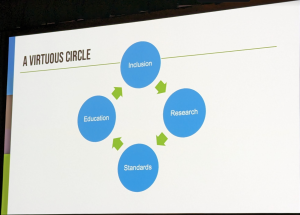
Presentation slide with four circles labeled Inclusion, Research, Standards, and Education, connected by arrows

Versa Press’ Matt Kennell got the day started by introducing a panel consisting of outgoing BISG board director and CEO of IBPA Andrea Fleck-Nisbet, James Miller of Barnes & Noble, and Joshua Tallent from Firebrand Technologies. The panel examined the approach of embracing a Virtuous Circle of Inclusion → Research → Standards → and Education, a theme which echoed across the day’s panels. The discussion touched upon the past Trends publication from BISG, the dozens of webinars and events that are supported each year via BISG’s staff of 2 full-time employees, and the efforts of volunteers on their committees, as well as how BISG continues to work closely with companies throughout the industry to curate virtual and in-person events exploring topics ranging from sustainability to metadata to workflow to rights to subject codes, and more. Lastly, the panel zeroed in on the primary goals for BISG to achieve during the next three years, including:

1. Transforming supply chain communication
2. BISG at 50 (which happens in 2026)
3. Resource development
4. Membership growth
5. Membership retention

The balance of the day saw sessions including:
  • “The Case for Royalty Statement Standards”, moderated by Kris Kliemann from Kliemann and Company, outlining the need for standards on royalty statements in the industry. Panelists included Jennifer Weltz (President, Association of American Literary Agents; President, Jean V. Naggar Literary Agency Inc.), Lucina Schell (International Rights Manager at University of Chicago Press), and Donna Laing (VP of Royalties and Rights Data Management at Scholastic). For those of us not involved in rights, this was a fantastic education on the challenges with administering rights and royalties with so many segments of the industry reporting back on sales and returns in different formats and with different expectations.
  • Ken Brooks (Amplify Education) moderated the session, “Moving Out of the Tower of Babel: Improving Efficiencies Across the Supply Chain”, featuring speakers Claire Holloway (Manager of Publisher Relations, OCLC), Alan DuBose (Senior VP of Planning & Data Analytics, Books-A-Million), and Jessica Wells (Penguin Random House). The supply chain is a topic a bit more ubiquitous than rights across the industry as we each have a role to play in it regardless of our vocation, and the exploration of issues related to forecasting, leveraging actionable data within different systems in our tech stacks, and identifying shared pain points put this topic into a shared frame of reference for all involved that spurred further discussions at the reception following the meeting. With the absence of one point of data in the US, as Booknet Canada supports within the Canadian market, there are ongoing challenges we’ll be working through with the help of organizations like BISG.  An example query that a unified data set could help answer for market research and planning was “How many copies of The Great Gatsby were sold across all publishers after it went public domain?” Having access to that type of unified data would help publishers make better decisions on whether to expand or adjust plans for certain titles in their public domain editions lists, for instance.  Everyone walked away from this session with a list to think about specific to their portion of a book’s life cycle.
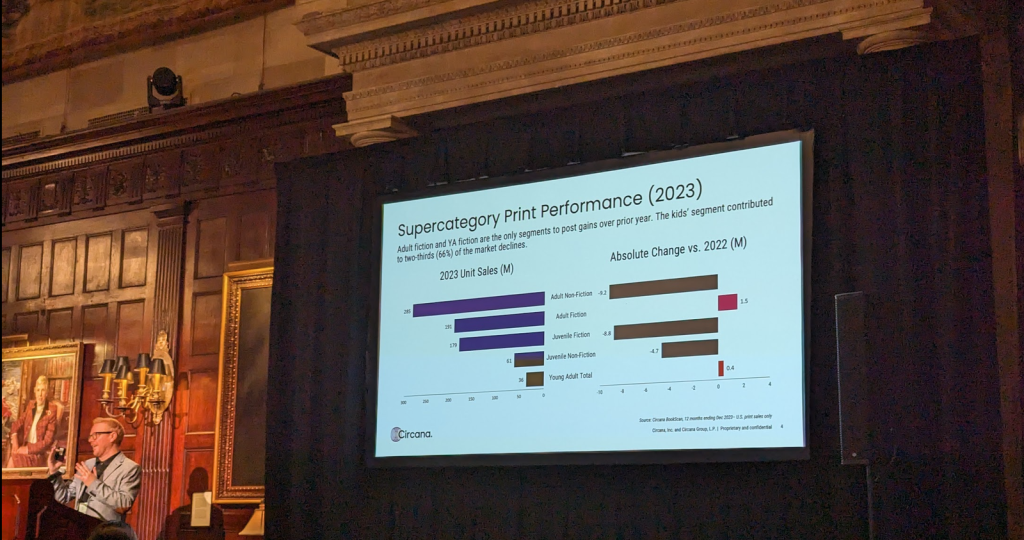
  • Connie Harbison (Baker & Taylor) conducted a “How Standards for Product Metadata Reflect Shifts in Culture” panel discussion with Geraldine Zephirin (Barnes & Noble), Michael Olenick (Clarivate), and Gina Wachtel (Penguin Random House) that looked at the need for standards, and leveraging BISAC Codes more effectively, as well as mapping them to Thema for international markets. The prior interim speech, “Metadata in Action: Understanding Industry Trends” by David Walter of Circana helped illustrate the picture of why clear, consistent metadata is important for helping ensure discoverability and industry tracking that benefits us all.  The panel’s emphasis on the practical – including hygiene tasks for clearing out outdated BISAC codes from your ONIX feed and metadata – made what can be an arcane topic accessible for those of us in the room who may not have a favorite BISAC code (as each panelist shared they did!).
Man speaking from podium at lower left hand corner of picture, with a large presentation screen behind him showing 2023 US Print Book sales figures
David Walter (Circana) discusses 2023 Supercategory Print Sales during BISG 2024 Annual Meeting
After lunch, three awards were presented including The Sally Dedecker Award for Lifetime Service to Phil Ollila of the Ingram Content Group, who was introduced by BISG and Stationers’ Company member Lorraine Shanley, and the BISG Industry Innovator Award presented to Scribd, who was represented by Andrew Weinstein.
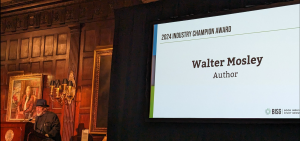
Author Walter Mosley addresses the BISG Annual meeting from the podium on the stage in New York City's Harvard Club
Walter Mosley accepting the 2024 Industry Champion Award during the BISG Annual Meeting on April 12, 2024

The 2024 Industry Champion Award was presented to Walter Mosley by Michael Pietsch, CEO of Hachette Book Group and Mosley’s former editor. Mosley received the award not only in recognition for his body of work, but for his founding of the Publishing Certificate Program at City College of New York (CCNY), his alma mater. His efforts in developing an educational program to create awareness of the opportunities in the publishing industry for people of underrepresented backgrounds was the primary topic in his introduction and in his own speech. To Mosley’s credit, he challenged the room to do more than give him an accolade and move on, but to instead follow his example of driving change in the industry by hiring people from different backgrounds and improving the diversity within the companies involved in publishing books, ensuring all voices and audiences are being seen, heard, and properly represented.

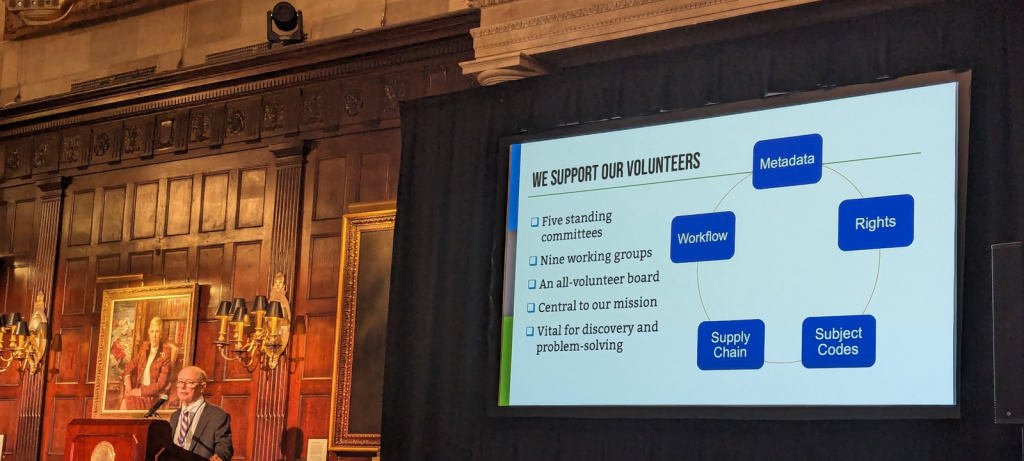
Executive Director Brian O’Leary’s closing session – Book Publishing Next: Changes We Want to See in the Industry – marked the first time Brian has given a keynote during his BISG tenure and provided a capstone to the day by walking through how all of the topics introduced earlier (rights, supply chain, subject codes, metadata, inclusion, and more) were the inspiration for the 3 year plan that had been introduced at the start of the day by the board. Brian highlighted how more growth can be achieved through better management of rights opportunities, managing costs, and being more consumer focused. Brian’s consultative approach to the info gathered through surveys and committee meetings leading up to the event hearkened back to a comment Phil Ollila had made earlier in the day, “People like to be engaged, not managed.” By encouraging ongoing engagement with the audience and the volunteers that comprise the bulk of BISG’s momentum, Brian underscored how the industry plays a vital role in making improvements for the continued benefit of everyone within publishing, rather than a one-way keynote closing the day’s sessions.

The below image cannot be emphasized enough – the volunteers drawn from all walks of the industry drive the content and mission of BISG, making meaningful events like the annual meeting itself and the ongoing webinars throughout the year possible.

Man standing at a podium with a presentation screen behind him showing squares with words including metadata, workflow, rights, supply chain and subject codes
Brian O’Leary, Executive Director of BISG, delivers closing keynote for the 2024 Annual Meeting
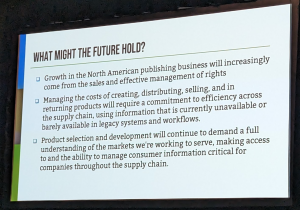
Presentation slide outlining future possibilities for publishing industry in North America
What Does the Future Hold – BISG 2024 Annual Meeting

In closing, what does the future hold? Well, Brian shared a few ideas but in the theme of the day’s session, why not join BISG, attend a committee meeting to contribute your voice to the discussion and help steer publishing’s future? More about BISG membership, which is open to companies and individuals, is available here.

Contact Us at Westchester to talk about highlights from the day, and ways we’re helping BISG member orgs and our hundreds of publisher clients around the world with their workflow challenges.


Filed Under: blog, Conferences, News, Services Tagged With: accessibility, BISAC, BISG, Booknet Canada, committees, discoverability, diversity, efficiency, growth mindset, industry communication, metadata, ONIX, publishing industry, representation, rights, royalties, Stationers' Company, supply chain, Thema, workflow, working groups

  • Page 1
  • Page 2
  • Go to Next Page »

Footer

We’re ready to help you!     Contact Us   Call +1 203-658-6581

About Us  |  Conferences  |  Press  |  Blog |  Careers  | Privacy Policy |  Education Services  |  Westchester UK
  • Email
  • LinkedIn
  • YouTube

Copyright © 2026 Westchester Publishing Services, LLC.

This website uses cookies to analyze traffic, improve your visit and to help us communicate more effectively with you. Our privacy policy has new information.   Accept Read Privacy Policy
Privacy & Cookies Policy

Privacy Overview

This website uses cookies to improve your experience while you navigate through the website. Out of these, the cookies that are categorized as necessary are stored on your browser as they are essential for the working of basic functionalities of the website. We also use third-party cookies that help us analyze and understand how you use this website. These cookies will be stored in your browser only with your consent. You also have the option to opt-out of these cookies. But opting out of some of these cookies may affect your browsing experience.
Necessary
Always Enabled
Necessary cookies are absolutely essential for the website to function properly. This category only includes cookies that ensures basic functionalities and security features of the website. These cookies do not store any personal information.
Non-necessary
Any cookies that may not be particularly necessary for the website to function and is used specifically to collect user personal data via analytics, ads, other embedded contents are termed as non-necessary cookies. It is mandatory to procure user consent prior to running these cookies on your website.
SAVE & ACCEPT