• Blog
  • Podcast
    • Publishing Fact or Fiction: Getting Ready for ADA Title II – Podcast
    • Westchester Words – All Episodes
  • WEBINARS
    • Publishing Now Fall ’24 webinar
    • Publishing Now Spring ’24 webinar
    • Publishing Now Fall ’23 webinar
    • Publishing Now Spring ’23 webinar
    • Publishing Now Fall ’22 webinar
    • Publishing Now Spring ’22 webinar
    • Publishing Now Fall ’21 webinar
    • Publishing Now Spring ’21 webinar
    • Publishing Now Summer ’20 webinar
  • About Us
    • Meet Our Team
    • Press
    • How Westchester Helps Publishers
    • Markets We Serve
    • Our Clients
    • Client Testimonials
    • Our Partner Network
    • Our Workflows
    • Conferences & Events
    • Publishers Weekly Special Report-Prepress Services
    • Careers
  • Contact Us
  • PORTAL LOGIN
  • Skip to main content
  • Skip to footer

Westchester Publishing Services

Excellence Delivered

  • Composition Services
    • Sustainable Typesetting®
    • U.S. Serviced Typesetting
    • Offshore Typesetting
    • LaTeX Typesetting
    • Pre-Edit Service
    • ePubs and Digital Conversion
    • Digitally Accessible Content Resources
  • Editorial Services
    • Domestic Editorial Project Management
    • Offshore Editorial Project Management
    • Art and Design
  • Client Portal
  • Westchester UK
    • Education – UK & International
    • Publishing – UK
  • Education Services

Cover to Cover: Textbook Design

Services

March 14, 2018

by Mark DaGrossa, Director of Creative Services

In this edition of Cover to Cover, I’m going to take you through the steps we consider when we are designing a textbook.

After the project is awarded to us, we assemble our team and get down to work. First, we determine whether we are creating a design template or if one will be provided. If we are creating the template for our client, we need to define several items, including:

  • Chapter openers, unit openers, covers, testing pages, activity pages – all need to have the same visual theme or family but may have their own feel.
  • Icons – need to be created for each sidebar item
  • Head treatments – the head in the general body of the text will be worked on, A-Head, B-Head, C-Head, and so forth.
  • Columns – how many should each page have?
  • Fonts – We need to select fonts that allow for several options within the font family.
  • Printing – This is important to ensure specific margins or gutter spaces are incorporated into the design.
  • Photos – Will they have square cuts, borders, vignettes, breakout images, outlines or drop shadows? We also consider how captions will be shown.
  • Footers and folios – What will go into these areas?
  • Book map – is there one which shows how the pages flow? This is important if you want each unit to open with a spread.

For projects that are more design intensive, once we have a design template established, we move on to verbal visual conferences (VVC) for the pages. A VVC is a meeting that brings together the editor, art researcher, and the designer.

In the VVC, the designer uses a printout of the loose version of the pages, including the items that are static on the pages. The designer works through the manuscript, page by page, with the editor and art researcher, drawing a sketch of how each page will look. The editor highlights what is important in the content, allowing the designer get a better idea of the look and flow of the page. This also gives the art researcher a clearer understanding of what they need to be looking for and how the images will be used.

VVCs are conducted in the earlier stages of the project using rough sketches and will change somewhat once the final images are found, chosen, and approved. I’ve included an example below of a rough sketch and the final version so that you can see the types of changes that occurred as the project took shape.

Another important detail we need to factor is what grade level the content is being designed and written for. The lower the grade level, the less text and more imagery will be used. Lower grades get a bigger, more easily read font. Leading is larger, and the actual writing is grade level specific. Colors tend to be a bit brighter and primary. The imagery is much larger and more specific to the content, allowing younger students to make a better connection between the words and pictures. As the grade level climbs into the middle and high school levels, less imagery is required. Font sizes will be somewhat smaller, and the colors for images may be more muted so as not to distract from the text.

As you can see, there are many important items designers, working with editors and the art team, consider. Effective design ensures students better understand the program.

I hope this post has helped you learn more about how designers approach working on a textbook project. I welcome your design questions and ideas for future blog post subjects. Feel free to email me at: mdagrossa@westchesterpubsvcs.com

Have a great day!

Mark


Filed Under: blog, Featured, Services Tagged With: Content, Design Services, Images, Photo Research, Template, textbook

February 28, 2018

by Michael Jon Jensen – Director of Technology

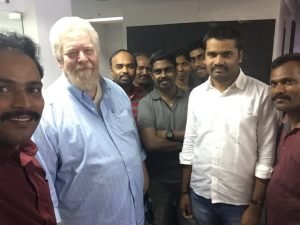
Michael Jon Jensen, and the software development team at Westchester’s Chennai office

I recently returned from my third visit to our offices in Chennai, India. The first trip seven months ago was an adventure and a revelation; the second, three months ago, was a return for strategic development. This most recent trip was a reunion with colleagues who I now consider friends, to refine our mutual long-term plans.

My first ever trip to India, in late April of 2017 — was a cultural whirlwind. The intersection between an ancient civilization, the impacts of a few hundred years of colonization, and 21st-century modernity means that Chennai lives all of them simultaneously. Their day-to-day traffic manifests that complex intersection: handcarts, bikecarts, scooters, motorcycles, three-wheelers, autos, small trucks, panel vans, and big trucks interweave constantly, usually gracefully (if terrifyingly hair-raisingly), blithely ignoring lane markings and traffic signs. I tried to put my foot through the floor so often that my right calf ached at the end of the first few commutes.

During that first visit to our Chennai offices, I discovered a depth of skill and capability that I’d only halfway understood. I found a desirable Indian workplace comprised of good jobs which were well-staffed, and a production workflow focused on quality-control at every stage, across the board.

I shouldn’t say I was “surprised” by anything I saw in our Chennai offices on that first trip. Before joining Westchester Publishing Services, I’d done due diligence by talking with a lot of publishers I knew to confirm their reputation before signing on, and to be sure that their Indian staff were well treated. I heard nothing but support.

What I saw on that first trip exceeded my expectations, and delighted me. I also reveled in the reality that at the Chennai offices we have our own software development team, who were already deeply knowledgeable about data transformations, typesetting nuances, as well as XML, EPUB, and textual presentations. These are things I’ve done and loved my whole career, and I realized that we could insource a lot of development, building internal strength, and creating some amazing tools together to serve our clients’ needs, and to expand what’s possible behind the scenes.

My job just got more exciting at that point.

My second trip, in August of 2017, was a solid week of engagement, bookended each day by that brief, routine commute in Chennai’s hair-raising traffic. That time, I complimented myself on only freaking out about the traffic once or twice per commute, such as when a family of five on a motorcycle swerved successfully around the three people on a scooter who were swerving around a slow-moving bicycle cart.

During that second visit, Elan and Christober (Development Chief and Head Architect, respectively) and I strategized out the next 18-24 months. From immediate priorities to stretch goals, we laid out what might be achieved given our existing strengths and client needs, and given our capabilities. Such fun, imagining what we could build. What kinds of hires would we want to make to achieve specific goals? What steps should we take now, to enable certain kinds of analysis a year from now?

Regarding this most recent third trip, begun when the January winter storm began?  Apart from my luggage finally arriving the day of my departure from India (a story for another day), it was sheer delight.  I was returning to meet with friends, people I had worked with to devise some radical improvements of already-streamlined production services, and to re-envision data infrastructure. Only geeks can get excited talking about the user interfaces for our backend workflows, which will also feed data to our client-facing Portal. And we were trans-Atlantic geeks, to be sure.

We’re already working out how to design a “scholarly EPUB” format optimally suited for scholars; refine image and textual analysis tools to flag possible problems like rivers, or stacks, or a disproportionate degree of “feathering”; identify the richest 25% of the document’s content; auto-categorize publications, via multiple frameworks (Amazon, BISAC, LC, etc.); identify most-related titles within a publisher’s WPS ouvre; and on and on.

Of course, we work on this stuff together daily from across the ocean, via Skype, phone, and email. But there’s nothing like being in the same room with really smart developers, brainstorming ways to enhance the quality, the beauty, the processes, and the value of the work we produce.

Best of all, during this visit’s daily commute, I didn’t slam on my “virtual brake” at all. I can’t say I was calm, but clearly, some part of me had become acculturated to Chennai’s traffic.

On my next visit to Chennai, we’ll hammer out the strategic structural necessities, and the required scripted processes to enable our next leap forward.

I can’t wait for that next trip!

– Michael

Filed Under: blog, Featured, Services Tagged With: analysis, backend workflows, Client Portal, data infrastructure, epub, software development, XML

February 23, 2018

Tim Davies, ALPSP UP Redux, Stationers’ Company – and more

By Tyler M. Carey – Chief Revenue Officer

Sign outside The British Library, site of the 2018 ALPSP UP Redux Conference

Westchester’s year is off to a great start, especially with the growth of our work in the UK market. As you may have seen a couple of weeks ago, we have brought on Tim Davies, formerly of The History Press and Oxford University Press, to help us grow our business in the UK.  Tim’s expertise running publishing companies, and his previous experience with American firms such as Baker & Taylor and Author Solutions has him uniquely positioned to help Westchester not just grow our client base, but also to identify any areas where we should grow. He is currently actively engaged in expanding our bench of copyeditors in Great Britain to help us stay ahead of the curve in our copyediting capacity as we grow.  And boy, are we glad Tim is doing that! At ALPSP’s UP Redux conference, there was a tremendous level of interest from the UK’s university presses about the work that Westchester does with many of their peers in the US, as well as more and more work with UK-based publishers.

Our friends at UCL Press hosted the recent ALPSP UP Redux, which was a well programmed conference for the university press and academic publishing spaces. The show had an international feel as a result of old friends from the States including Duke University Press and The MIT Press sending staff, giving the conference a set of contrasts to draw from for sessions and discussion. The US presses that came gave helpful, proven insights on where the US university press space has been and where it’s going; The MIT Press’ Amy Brand’s Keynote was particularly effective in exploring these areas. Timothy Wright (Edinburgh University Press), David Prosser (RLUK) and his panel, and Bloomsbury’s Richard Charkin also contributed quite a lot of perspective about where academic, university press, and library programmes have been headed. Andy Redman from Oxford also provided a very practical walkthrough of how a larger university press has embraced XML-first production to handle its large legal list, tying in nicely with the later panel on “buy vs. build” regarding tech platforms.

From the UK perspective, the use of Open Access as a mechanism to help grow presses rapidly was covered by UCL Press and other UK based presses, as well as JSTOR’s Frank Smith who added to the global perspective by talking about how Open Access has helped put scholarly content into the hands of scholars and consumers in emerging markets. There was some debate on this topic, but based on the successes of smaller start-up university presses in the UK – as well as those like UCL Press that have experienced growth fueled by open access – it was impossible to challenge the use of Open Access as a way to launch a program. The debate did continue though, as it pertains to the Higher Education Funding Council for England’s (HEFCE) position that all UK monographs need to become open access in the near future. You can read more about publishers’ concerns regarding HEFCE’s stance in this article by The Bookseller.

Another highlight for me was once again visiting Stationers’ Hall for the New Members evening at The Stationers’ Company. While I’m still very much a new recruit myself, it was great to speak with other publishing professionals who are interested in joining the Company, as well as seeing old friends who have been members for years. Of special focus during the evening’s open presentation was a focus on the Stationers’ Academy and other charitable programmes run by the Company. It was inspirational to hear members speak of the mentoring work they do to help children better navigate their education and early professional development. There is truly a commitment at the Company to help others, while also ensuring that publishing continues to remain a viable path for young graduates, keeping up the Company’s more than 600 years’ worth of work growing the industry.

During the remainder of my trip to London, Tim and I took the opportunity to meet with existing partners. We also took time to plan for the upcoming IPG Spring Conference (if you haven’t registered yet, mention Westchester when you do) and the London Book Fair.  Westchester will have stands at both conferences and we’re eager to talk about all the great work we are doing with publishers in the US, and increasingly in the UK and Europe.  Please contact us to arrange a meeting to discuss your publications program and ways we can help.

Filed Under: blog, Conferences, News, Services, Westchester UK News Tagged With: ALPSP Redux, Stationers' Company, Tim Davies

February 1, 2018

by Mark DaGrossa, Director of Creative Services

Hello everyone! In this post, I will cover general use images and where we obtain them. As we work on most design projects, there is always a need to find the perfect image to enhance the design of the project. It may be a full page image, an image to use as an icon, or an item collaged into a header. No matter what the use, it is very important to follow the correct procedures for acquiring an image.

For example, did you know you cannot simply use anything you find on the Internet? If you do a Google Image search, many images will pop up. However, that doesn’t mean you have permission to use any of them.

I had no idea! So where can I find the images I need for our project?

If you need a simple image of a pencil, for example, you can probably do that yourself using a smartphone or digital camera. You could try to find free image resources online, though it can be tricky to determine what is actually free to use. For projects that are more specialized, it’s always best to retain the services of a designer. Designers possess the artistic training and access to image resources that will enhance the look and feel of your project far better than if you attempt to do the work yourself.

Many of the images designers use come from photographic stock houses, which offer professionals a huge selection of royalty free images, and are a very helpful resource when you’re trying to find a specific image. Most of these images can be manipulated and used however you need for the final design.

For certain projects, we need one amazing shot of a specific item or place. In that situation, we will often use a photographer based in that region. I recall a project where we were working on a sales incentive program and found this spectacular image of the destination hotel the clients were using. It was taken by a local photographer who only shot fine art images of Florida. A deal was worked out with all parties to use the images and the final product was completed for the client.

When a project requires images from a certain time period or place, then we work with museums or historical societies to source and use images from their collections. For example, if you need a tree from a specific natural park in Indiana, the designer will need to find a source who can verify that this tree is from this forest. You will not be able to just use any tree, especially if the description in the book calls out the tree and forest.

In conclusion, using the services of a designer is cost-effective because a designer will work with you to make sure that your design aesthetic is followed. They will coordinate with the owner of the images to obtain the necessary permissions or will find another reputable source to acquire pictures which suit your project. Working with a designer prevents the problems that can occur when images are obtained without receiving authorization from the artist to whom the work belongs. Resolving these issues can often cause delays that can be costly and time-consuming to fix. If you use a designer from the beginning, the process will go far more smoothly and you’ll end up with a project which is exactly as you envisioned, or even better.

Have a great day!

Mark

Filed Under: blog, Services Tagged With: Art, Design Services, Images, Page Design

January 11, 2018

By Nicole Tomassi, Marketing and Conference Manager

In 2017, Westchester Publishing Services enjoyed several significant accomplishments, and we’re already hard at work to build upon those successful initiatives in 2018.

These achievements are possible thanks to the efforts of our employees, along with the trust placed in us by our valued clients. Together, they made 2017 a year we look back on with pride, and we hope 2018 will be an equally successful year for all.

Conferences, tradeshows, and events, oh my!

In 2017, Westchester significantly increased our sponsorship and attendance at conferences and events in publishing, including  Council of Science Editors, Association of American University Presses, Publishers Weekly Star Watch, and National Council of English Teachers among others.

Increasing the growth of our client list

Throughout the year, Westchester Publishing Services became the provider of editorial or composition services to several more publishers, including signing multi-year agreements with prestigious publishers  The MIT Press and Rutgers University Press.

Meanwhile across the pond…

We further expanded our presence in the UK during 2017, sponsoring and attending conferences including London Book Fair, The Bookseller Children’s Conference and FutureBook. We also became a member of the Independent Publishers Guild, which has been an advocate for independent publishers for 55 years.

Expanding into new markets 

In May, we launched our  K-12 Publishing Services division, led by Managing Director, Kevin Gray, who has an experienced and talented team to meet the demand for high-quality content development our clients require.

PW Digital Solutions in India Special Report

Each year Publishers Weekly looks at the developments and innovations in digital production in their Digital in India supplement. We received significant coverage in the July 3rd issue and are proud of being the only US employee-owned company profiled who has full ownership and hands-on management of our production facilities in India.

Strategic partnerships

Shortly before the  EdNET conference this past September, we announced our collaboration with the well-respected digital content provider FableVision Studios. More exciting developments are on the horizon with FableVision Studios as well as other companies in the ed-tech industry, so stay tuned!

Better by design

In November, Westchester Publishing Services brought  Mark DaGrossa on board as our Director of Creative Services. Mark’s extensive knowledge and resources allow us to significantly increase the design capabilities we are able to provide publishers for their titles.

An updated website and Client Portal

On the digital front, we gave our website a makeover, which made it more functional and user-friendly. We also unveiled a new version of our Client Portal

New faces and milestone anniversaries

Westchester Publishing Services has been growing steadily in recent years, with approximately one-quarter of our team joining the company since 2014. We are also fortunate to have employees who have been with us for 20 years or longer, including Roger Mahaffey and Sue Shaw, who each recently celebrated 25 years with Westchester. Bill Foley joined the company in 1976, making his impressive tenure second only to our Founder and CEO Dennis Pistone. Congratulations to all on your careers with Westchester!

Lending a helping hand

Being involved in our local community is important to us at Westchester Publishing Services. In addition to providing a financial donation supporting the efforts of the Connecticut Food Bank, some of our employees also gave of their time to help fill backpacks of food for distribution to area schoolchildren. These backpacks ensure families in need have access to nutritious food when school-based resources are not available. Feeding America has information on how you can support a foodbank in your local area.

A look ahead: 2018 conferences and trade shows

In 2018 Westchester Publishing Services will be involved in more industry events than ever before. We have made sponsorship and attendance commitments for several conferences and tradeshows in the US and the UK, including:

  • PubTech Connect
  • London Book Fair
  • Council of Science Editors
  • SIIA/CODiE Awards
  • Association of University Presses
  • EdNET
  • FutureBook

Visit our events page for a complete list, and contact us to set up a convenient time to talk! We look forward to learning more about how we can help you resolve your editorial, design, or production challenges in the year ahead, so you can fully focus on growing your company in 2018 and beyond.

Filed Under: blog, Conferences, News, Services, Westchester K-12 News, Westchester UK News

  • « Go to Previous Page
  • Page 1
  • Interim pages omitted …
  • Page 13
  • Page 14
  • Page 15
  • Page 16
  • Go to Next Page »

Footer

We’re ready to help you!     Contact Us   Call +1 203-658-6581

About Us  |  Conferences  |  Press  |  Blog |  Careers  | Privacy Policy |  Education Services  |  Westchester UK
  • Email
  • LinkedIn
  • YouTube

Copyright © 2026 Westchester Publishing Services, LLC.

This website uses cookies to analyze traffic, improve your visit and to help us communicate more effectively with you. Our privacy policy has new information.   Accept Read Privacy Policy
Privacy & Cookies Policy

Privacy Overview

This website uses cookies to improve your experience while you navigate through the website. Out of these, the cookies that are categorized as necessary are stored on your browser as they are essential for the working of basic functionalities of the website. We also use third-party cookies that help us analyze and understand how you use this website. These cookies will be stored in your browser only with your consent. You also have the option to opt-out of these cookies. But opting out of some of these cookies may affect your browsing experience.
Necessary
Always Enabled
Necessary cookies are absolutely essential for the website to function properly. This category only includes cookies that ensures basic functionalities and security features of the website. These cookies do not store any personal information.
Non-necessary
Any cookies that may not be particularly necessary for the website to function and is used specifically to collect user personal data via analytics, ads, other embedded contents are termed as non-necessary cookies. It is mandatory to procure user consent prior to running these cookies on your website.
SAVE & ACCEPT