• Blog
  • Podcast
    • Publishing Fact or Fiction: Getting Ready for ADA Title II – Podcast
    • Westchester Words – All Episodes
  • WEBINARS
    • Publishing Now Fall ’24 webinar
    • Publishing Now Spring ’24 webinar
    • Publishing Now Fall ’23 webinar
    • Publishing Now Spring ’23 webinar
    • Publishing Now Fall ’22 webinar
    • Publishing Now Spring ’22 webinar
    • Publishing Now Fall ’21 webinar
    • Publishing Now Spring ’21 webinar
    • Publishing Now Summer ’20 webinar
  • About Us
    • Meet Our Team
    • Press
    • How Westchester Helps Publishers
    • Markets We Serve
    • Our Clients
    • Client Testimonials
    • Our Partner Network
    • Our Workflows
    • Conferences & Events
    • Publishers Weekly Special Report-Prepress Services
    • Careers
  • Contact Us
  • PORTAL LOGIN
  • Skip to main content
  • Skip to footer

Westchester Publishing Services

Excellence Delivered

  • Composition Services
    • Sustainable Typesetting®
    • U.S. Serviced Typesetting
    • Offshore Typesetting
    • LaTeX Typesetting
    • Pre-Edit Service
    • ePubs and Digital Conversion
    • Digitally Accessible Content Resources
  • Editorial Services
    • Domestic Editorial Project Management
    • Offshore Editorial Project Management
    • Art and Design
  • Client Portal
  • Westchester UK
    • Education – UK & International
    • Publishing – UK
  • Education Services

Fall 2023 Conferences and News from Westchester

Services

October 4, 2023

by Tyler M. Carey, Chief Revenue Officer

headshot of Tyler Carey2023 has been another busy year here at US employee-owned Westchester Publishing Services, as we continue to expand our stateside and offshore operations to further support our clients’ editorial and production needs. In addition to our standard editorial and production work, we are supporting numerous clients who are expressing increased interest in scanning backlist titles, print-on-demand file requirements, accessible ePubs, developmental editing, permissions, and author support tasks.  Across our global operations based in the US, UK, and India, we now support approximately 600 clients around the world. We appreciate the feedback from these partners that has helped us better understand how we can work with publishers and content providers to resolve their problems and deliver quality publications to their readers. 

To best support both client growth and the additional services we are providing, we announced two promotions earlier this Summer.  Deb Taylor has been promoted to our Chief Operations Officer, and Christober Masilamani has been promoted to our Managing Director for our Chennai, India production operation.  More information about their new roles can be found in this press release.  Let me know if a discussion with Deb or Christober about incorporating your needs into our plans and direction would be helpful. You can Contact Us anytime to schedule a discussion with your sales point of contact and our leadership team. 

We enjoy having an ongoing dialogue with the market about topics impacting our industry. Here are a few discussions that may be of interest to you: 

  • Last month, I spoke on the Publisher Nation podcast with Digital Book World’s Bradley Metrock – and industry thought leaders Lorraine Shanley (Market Partners International) and Andrea Chambers (NYU Masters in Publishing) – about how publishers are exploring AI within their workflows. You can watch the YouTube feed of our discussion. 
  • On October 10th, I will be presenting on the “Amplifying Impact” panel at Dropbox’s Work in Progress conference in New York City. I’ll be speaking about how we partnered with Dropbox to build out our Client Portal, and how both of our organizations continue to explore ways publishers and media organizations can leverage tools and technology to make their work more efficient.  You can sign up for this one-day event on Dropbox’s site. I’ll also share a blog post afterwards with info about the day’s content and any best practices that may be worth tracking. 
  • Most exciting of all, our next Publishing Now webinar – launched in partnership with Publishers Weekly – is coming up on Thursday, October 26th.  Speakers include Marina Padakis Lowry from Union Square & Co., Diem Bloom from Johns Hopkins University Press, and Bill Rojack from Midland Paper and Two Sides North America. Our panelists will be exploring the ways books are being produced in our new normal, including topics related to AI, workflow, and working with partners. You can sign up here. 

If there are any areas where you have questions, contact us to schedule a brief Zoom. We always like to help, even if that means connecting you with our partners who may be better able to support those needs that are outside our area of expertise. I would welcome the chance to hear from you, and learn more about what you’re exploring with your 2024 publications program. 

Filed Under: blog, Conferences, News, Services Tagged With: accessible ePubs, AI, Client Portal, collaboration, developmental editing, Dropbox conference, editorial, epub, Johns Hopkins University Press, Midland Paper, print on demand, Production, Publishers Nation podcast, Publishing Now webinar, scanning titles, Union Square and Co., workflows

June 27, 2023

by Tyler M. Carey, Chief Revenue Officer

headshot of a bearded man wearing glassesIt’s been a busy few weeks for me, meeting with some of our clients about expanding our support for their lists, this year. During these meetings, two topics have been coming up again and again. Accessibility — and AI.

For the former – accessibility – Westchester has a lot of resources that we can bring to bear to help. If you’re at all looking for further support in making your content — whether upcoming titles or backlist — accessible, please do reach out. Westchester became a GCA-certified vendor in 2021 to help publishers with their accessibility needs for ePubs. We also joined DAISY to further our knowledge and support for accessible content. In an ongoing basis, we’re keeping track of emerging trends in ePubs, Accessible PDF’s and more, including these recent changes for ePub files from the W3C. Personally, I’m on the Workflow Committee of the Book Industry Study Group, where my talented colleagues on the committee recently released this update regarding fixed layout ePubs. We’re helping with tasks from WCAG compliance to creating alt-text entries to large-scale backlist scanning and conversion projects. This recent IBPA webinar I participated in with Michael Johnson from Benetech covers some highlights to consider.

For the latter topic – AI – well, I’m not sure any of us have a clear vantage into how GPTs and emerging tools will impact our business in the long term. The team at Westchester have been using scripts and natural language processing for years to help automate repetitive tasks and run some of our comparisons and checks. Much as indexing software became a tool for trained indexers to use to organize keywords and condense the time it takes to index a book, AI will likely be used to help improve accuracy and create even more efficiencies in various parts of the publishing workflow. The talented publishing professionals at Westchester Publishing Services establish the gold standard in our industry, and using a variety of technologies to provide high quality solutions for our clients is simply part of our DNA. I know we’re already harnessing AI in specifics areas of our toolsets. I’m looking forward to seeing how our team will continue to evolve and develop more solutions that benefit our clients and the industry as a whole.

In case you missed it, this article by Thad McIlroy in the June 6 issue of Publishers Weekly, provides a bit more of a stimulating viewpoint on the subject. And this article exposes perhaps the extreme case of trying to automate as much as possible with AI – and the negative impact it can have on content and the people who collaborate with you on your content.

While these strategic discussions are happening in all of our shops, I still remain grateful that the majority of my time is being spent exploring the editorial and production services the industry has come to expect Westchester to handle with care since the launch of our company in the 1960s. Much like the rest of the publishing industry, we continue to pivot and evolve, but remain steadfast to striking the right balance between technology and human expertise to allow our clients to trust their publications with Westchester.

How can Westchester help you for the balance of the year on your projects? Whether it’s helping with manuscript prep, typesetting, copyediting, or other tasks for your titles and assets, just reach out, we’ll be here for you.

Filed Under: Featured, Services Tagged With: accessible ePubs, AI, artificial intelligence, ChatGPT, copyediting, Epub3, manuscript review, Production, typesetting, workflow solutions

March 20, 2023

by Tyler M. Carey, Chief Revenue Officer

headshot of Tyler CareyWestchester Publishing Services has decades of history helping different types of publishers and content providers, including trade publishers, children’s publishers, K-12 EdTech platforms, think tanks, legal publishers, industry trade publishers, and many other types of organizations that create and distribute content.

Whether the project is a manuscript for an illustrated board book for children, assessment items for an online learning platform, or a policy paper intended for presentation on Capitol Hill, Westchester has specialists who can help edit, design, and layout the content for the right audience.

Specialized Publication Programs

Trade Associations – and related organizations like professional societies – often have rather different kinds of publications programs from typical publishers. While some industry-driven organizations have book or journal publishing programs focused on topics relevant to their domain area, many have varied publications from professional development content to white papers to conference proceedings to blog posts, each requiring different levels of support, expertise, and workflow customizations.

Here are examples of recent projects trade associations partnered with Westchester Publishing Services on:

• Helping a trade association modify content from their conferences and annual meetings into WebPDFs and ePubs. This content was then made available on their website for free download by members and for purchase by non-members. Conference proceedings in particular can be an area where professional societies and trade associations have content, but it’s laborious to produce rapidly – and in all the needed formats – once a conference wraps.
• Working with a trade association that provides content to medical professionals in a very specific field to create children’s publications to be used by their industry when working with young patients to help them understand and navigate a specific medical condition.
• Partnering with a bar association to better package updates to state statutes into book publications that allow attorneys to quickly understand changes to the laws in their area of practice, as well as access direct links to Fastcase citations in their digital editions.
• Supporting a medical association with editorial and production resources to help them present the best quality professional development and continuing ed materials to be shared with doctors in their specific discipline.
• Helping an educational industry organization edit and typeset new editions of their backlist titles, updating industry standards and information without writing wholly new manuscripts.
• Ongoing editing for industry journals in topic areas including medicine, mathematics, and social sciences.
• Editing and typesetting titles on subjects including management, business technology, and corporate finance for a prominent organization that tracks trends in these areas.
• Creating abstracts, executive summaries, and even tweets that an organization can share as abbreviated versions of their larger studies and white papers, letting industry executives skim the highlights before diving into 200+ page analytical studies.

Different Content, Different Distribution Channels

If you work for a trade association or professional organization, chances are good that you have historically handled your publications and content in ways that differ from your peer associations. Oftentimes, a trade association’s content grows organically as new distribution channels or newer media for online ingestion of content become available. Westchester’s expertise supporting different types of content and distribution methods for academic, trade, and policy groups, is easily applied to the needs of trade association partners to identify cost-effective solutions that will allow your association to efficiently and affordably build new content and expand your publication program.

The team at US employee-owned Westchester Publishing Services would be happy to explore how we can help you edit, design, and present your content, as well as share our expertise about how other organizations have navigated similar challenges using industry partners, new channels for distribution, and more. Contact us to talk about the content you currently manage, how you’re looking to engage with your association or industry, and solutions we can provide to help you achieve your goals.

Filed Under: blog, Featured, Services Tagged With: abstracts, conference proceedings, editorial services, executive summaries, production services, professional development content, publication program, trade associations, white papers, workflow, workflow customization

January 23, 2023

by Tyler M. Carey, Chief Revenue Officer

It has been longer than I would have liked since I last shared a post-conference blog post. I am glad that NYC’s Digital Book World (DBW), held January 16-18 at the Sheraton on Seventh Avenue, afforded me the opportunity to reconnect in person with many of Westchester’s partners and those of our clients who were able to make the trip to New York for the meeting.

As noted by Lorraine Shanley in her coverage of DBW in MPI’s Publishing Trends newsletter, the attendance was a bit upside down with far more vendor and industry types than publishers, it appeared. That said, the panels presented provided more than a little food for thought on topics ranging from the role of AI in publishing, to how to market books effectively online in the current landscape, to where we’re all headed as an industry.

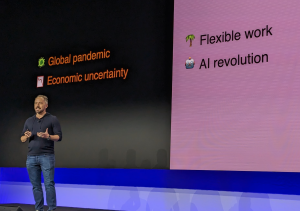
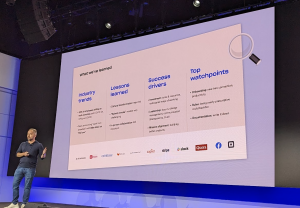
Screenshot from keynote speechIt was on that latter topic that Margot Atwell, the executive director and publisher of The Feminist Press, provided an insightful session. She revisited a presentation she had shared at London Book Fair in 2019, in which she had identified a number of trend lines in the industry – including equity, consolidation, and the financial health of the industry – and updated her analysis and predictions for 2023. Whether you were representing a vendor, a large publisher, or a start up, her insights on how to foster equity, continue to adapt to a distributed workplace, and navigate the financial and societal challenges in our industry resonated.

Aligned with another one of Westchester’s core principles was the panel on accessibility hosted by Bill Kasdorf, who was a panelist on our September 2022 webinar about accessibility and sustainability. Joining Bill were Michael Johnson from Benetech, Madeleine Rothberg from WGBH, and Richard Orme from the DAISY Consortium. As a Benetech GCA-certified partner, Westchester is keen to help amplify the messaging around not just the needs for accessibility but also the best practices that publishers can adapt into their workflows. Each panelist shared a headline and several discussion points with one another to help further discussion about the needs for publishers to accelerate their adaptation to support readers requiring accessible content. As the coverage of Day 1 of the conference in Publishers Weekly emphasized, Michael Johnson laid out numerous examples of the prevalence within the population of individuals who need or use adaptive technology to consume content. With an estimated 20% of the world’s population having a need, this isn’t a nice to have, it’s a necessity for ensuring as many readers can consume your content as possible.

Bill Kasdorf put perhaps the finest point on the subject by pointing out that due to the European Accessibility Act, if you plan on selling any ePub content in Europe by 2025, that content has to be created accessible or converted to accessibity standards – including backlist content – or it will be illegal to sell within the EU. But, to the point of everyone on the panel, that doesn’t necessarily mean a gigantic investment of resources or a total revision to how you create content. Micromoves internally and with partners can help pick away at the pile quickly and affordably. One key topic that seems to frustrate many publishers is that of alt text. While there are commonly accepted practices, the ‘right’ alt text is not codified the way that say metadata rules might be. As Michael Johnson pointed out, the same image could have different tags depending on its use. An image of the Eiffel Tower in a cookbook about crepes may be ornamental – not relevant to how to make a crepe – so it could just be labeled as “Ornamental” in its alt text entry. In a book about Paris, perhaps a few brief sentences describing the image of the Eiffel Tower would be appropriate. In an engineering book, the Eiffel Tower image might be being used to augment some content about the tensile strength of steel so a different, brief entry would be called for. But in none of these instances is a thoroughly written, revised, and breathtaking narrative called for – alt text entries are there to tell a reader what is in the image, not replace the content that is already in the text that the image is intended to augment. And to Madeleine Rothberg’s point, there is a metadata field called “Accessibility Summary” in each file that allows you to make notations re: pieces that are works in progress, absent, etc., understanding that there will be exceptions and things that may need further attention after initial creation or conversion. We’re all learning new things regarding accessibility – even those of us who are deeply involved in accessibility – and this field serves as a placeholder to indicate where we think something may need to be revisited.

To help us all navigate the world of accessibility, and better plan for the looming EU deadline referenced above, a number of resources were shared by the panel that Bill Kasdorf consolidated here. I highly encourage you to review these resources and share them with any of your team involved in working with authors, editing content, and producing digital files.

Other excellent sessions included Ingram’s presentation about its Ingram iD platform, which allows for direct-to-consumer marketing, sessions from Scribd and Spotify about different revenue models for content distribution, and sessions from AI firms showing how audiobooks and more can benefit from AI.

Westchester’s Vice President of Business Development and Marketing, Deb Taylor, attended DBW as well, and provided this commentary about ChatGPT coming out of a session hosted by another vendor in our space.

Deb shares:

DBW’s sessions were typically not company/product commercials, although like most conferences, a few did lean that way. When the Trends in Content Creation Using AI and Smart Technology session by PageMajik started, I think most expected it to be a carefully disguised commercial about their services. It turned out to be a micro master class in how to think about AI and, in this case, the “controversial” open source AI, GPT3 (or ChatGPT). Keep in mind, PageMajik wasn’t the only one discussing AI and how it has many places in publishing – we learned about interesting uses of AI in audiobook production workflows, and in the use of synthetic voice, too.

So while ChatGPT has been banned on some school networks due to fear of plagiarism, this session reminded us that this is just technology – clever technology, mind you – but still just technology, and we, as humans can make a choice in terms of how to use and deploy it.
“We can be lazy, or we can be productive. The choice is ours.” And yes, we should be mindful that clever technology like GPT, does need some guardrails so it can be harnessed with positive productivity, not laziness or malintent.

For those who are wondering how ChatGPT can be purposeful in the publishing industry, here are a few thoughts:

1. One potential use case is for content generation, where the model can be trained on a specific topic or writing style, and then used to generate new articles, blog posts, or other written content. Additionally, ChatGPT can be used for editing and proofreading by identifying grammar and style errors in existing text. It can also be used for summarizing long articles or books, creating headlines and summaries for news articles, and even writing personalized responses to readers’ questions or comments. Overall, ChatGPT offers a powerful tool for automating and enhancing various aspects of the publishing process.

2. Another area in the workflow that often requires much back and forth with authors and copyediting teams is the reviewing, checking, and correcting of references and citations. ChatGPT can help with reference citation checking in manuscripts by using natural language processing (NLP) techniques to identify and extract citations from the text. Once the citations have been identified, the model can then compare them to a database of references to ensure that they are accurate and properly formatted. Additionally, ChatGPT can also be trained on specific citation styles, such as MLA or APA, to ensure that the manuscript adheres to the appropriate guidelines. It can also be used to check for missing references or duplicate citations in the manuscript. Overall, ChatGPT can provide a powerful tool for automating the reference citation checking process, which can help to save time and improve the accuracy of the final manuscript.

I’ll leave you with this final disclosure: Both the paragraph on use cases and reference citations were written by ChatGPT, in seconds. Would that be categorized as lazy? No. I believe it was incredibly efficient, however, the best use may be more in the middle. Let ChatGPT be the tool to help you formulate your idea but perhaps not be used verbatim. After all, it’s just technology, and it’s using what it has access to. You still need to validate the information. Try it out for yourself here. And then make sure to ask what its limitations and challenges are.

In general, these new aspects of technology are exciting and ones that we should not be fearful of, but figure out how to use to improve and advance our industry as a whole.

While there was a bit of humor artfully weaved into Book.io’s session, Digital Ownership, NFTs and Revenue Streams for Publishers, there were some interesting things to think about as it relates to the personalized marketing opportunities and the new potential revenue stream that blockchain could offer. eBooks, as we know, are meant to be licenses to the individual to “view, use and display” without any permissions to sell, rent or distribute otherwise. Digital books on the blockchain change that paradigm, and also enable the publisher to experience an ongoing revenue stream from books sold here. Per Book.io, it will increase the intellectual property value of the content. There is also the opportunity for the publisher to direct market the owner since there is more visibility in the digital ownership – think here about gating content with permissions, and even price points to owners vs non-owners. There are efficiencies (multiple languages), interesting design opportunities (different cover designs), unique targeted marketing ideas, and more here. As with all new technology, let’s not dismiss or fear it, but rather let’s get to know and harness it to continue to advance our industry.

—————————————————————————————————————-

Further coverage of DBW 2023 is available in this post from Publishing Perspectives that provides thorough coverage of keynote speaker Karine Pansa’s presentation about her mandate and expectations for her term heading the International Publishers Association, as well as this article from Publishers Weekly highlighting information for publishing start ups.

As always, US employee-owned Westchester Publishing Services is keen to learn more about which portions of your book production workflow you are navigating, in the hope that we can help. Over 500 publishers rely on Westchester for services ranging from manuscript preparation to editorial services to quality, on-time printer file production and accessibility remediation. Contact us today to talk about your publications and how we can help.

Filed Under: Conferences, News, Services Tagged With: accessibility, accessible ePubs, AI, artificial intelligence, audiobooks, blockchain, ChatGPT, conferences, content distribution, Digital Book World, editorial services, epub, EU Accessibility Act 2025, Events, intellectual property, International Publishers Association, IP, IPA, metadata, NLP, production services, publishers, workflow

January 10, 2023

The Benefits of Using the Right Vendor Instead of In-House Resources

In my previous article, “The Benefits of Sending Pre-Press Production Work to a Vendor,” I discussed the potential cost savings publishers can achieve when using a large pre-press production vendor with an India based composition house vs. handling this pre-press work in-house. In this article, I will focus on the question of vendor quality compared to the quality of final work product produced by in-house staff.

To jump right in, let me give you two key reasons why a large vendor can (let me emphasize “large” and “can,” which I’ll come back to) achieve better work product quality than in-house staff:

1. Expert Staff – The professionals and staff handling each task along the production workflow are specialists, experts in performing their specific responsibility – back to the time-honored principle – practice (or experience) makes perfect. Adding to this, because a service vendor must have experts in each task along the workflow, they must ensure each expert is well-trained and continues to learn about new systems or processes – otherwise, they will lose the game.

2. Quality Controls – Despite the fact that a provider has experts handling each task, those experts are human beings, and they will occasionally make mistakes. A good service vendor understands they must have comprehensive Quality Control procedures to identify and correct any errors that might occur.

Using baseball as an analogy, while a publisher can bring on experts in any and all tasks within their production workflow just as a service provider does, is it possible once the publisher has brought in that expert “shortstop” to keep the shortstop playing in that position full time? Without a substantial and steady volume of projects flowing through the workflow, and all the other positions filled with their own experts (1st base, catcher, etc.), I submit the answer is no, it’s not possible for that in-house expert to only handle one key responsibility. The next question a publisher has to ask themselves if how much training, most importantly on-going training will they be able to provide for those in-house experts receive? I’ve worked in several very large companies, and job-specific training after day one was practically non-existent. As a practical matter and a reality, It’s just not realistic from a financial standpoint for a publisher to maintain experts at each stage of the pre-press production workflow.

As a vendor providing a service where product quality can mean the difference between a successful business and total business failure, it would be playing Russian roulette not to have comprehensive Quality Control procedures in place. In this case, we’re talking about the primary product of publishers, the books and other publications they sell, where even a single quality failure could have disastrous implications. At Westchester, we have QC procedures in place aimed at achieving 100% quality assurance. While it is possible for a publisher to have similar QC procedures in place, often the pressure of keeping internal costs low wins out over having the extra staff necessary to perform those QC functions. Ultimately, the risk of quality issues getting through to final publications are a trade-off these publishers live with, but they don’t have to.

Now let’s come back to why a “large” vendor “can”.

The importance of being a “large” vendor is related to the challenge of a publisher having experts in each key position along the workflow. In order to maintain experts in each key position, there must be a volume of work to keep them engaged and productive in that position. If you only keep an in-house paginator engaged part-time setting pages in InDesign – and doing completely different tasks the rest of the time – will they ever be as good and efficient as someone doing the same task full time? Being a large vendor ensures the volume of work necessary to keep the experts in place in all positions at all times, performing at the top of their game.

The importance above of saying a vendor “can,” relates to a common complaint in today’s pre-press production service market. Large service providers may have the resources and the impetus to institute comprehensive QC procedures which ensure very high-quality end product – but many do not. At Westchester, we take pride in separating our company from those vendors who are unable to deliver near-perfect quality. Once again, we aim to achieve 100% quality assurance for all our publisher clients.

You might be asking, can a vendor provide all this, experts along the entire workflow plus comprehensive quality control procedures? Tying back to key points in my previous article about higher vendor efficiency, the answer is yes, as a result of larger volumes as well as an extremely cost-efficient workforce on the typesetting side of the workflow.

Westchester Publishing Services with our 40+ U.S. based production editors/project managers, 450+ network of copyeditors, a U.S. based customer service department, and 100% company owned and U.S. managed composition/typesetting facilities located in India, is the only U.S. employee-owned company of scale focused solely on pre-press production services. Let us take care of the editorial and production and after we take care of the coordination and hand-off of your final print files with your designated printer, we’ll leave the printing to the experts in that field.

Filed Under: blog, Services Tagged With: Composition, editorial services, pre-press, Production, production services, quality control

  • « Go to Previous Page
  • Page 1
  • Page 2
  • Page 3
  • Page 4
  • Page 5
  • Page 6
  • Interim pages omitted …
  • Page 15
  • Go to Next Page »

Footer

We’re ready to help you!     Contact Us   Call +1 203-658-6581

About Us  |  Conferences  |  Press  |  Blog |  Careers  | Privacy Policy |  Education Services  |  Westchester UK
  • Email
  • LinkedIn
  • YouTube

Copyright © 2026 Westchester Publishing Services, LLC.

This website uses cookies to analyze traffic, improve your visit and to help us communicate more effectively with you. Our privacy policy has new information.   Accept Read Privacy Policy
Privacy & Cookies Policy

Privacy Overview

This website uses cookies to improve your experience while you navigate through the website. Out of these, the cookies that are categorized as necessary are stored on your browser as they are essential for the working of basic functionalities of the website. We also use third-party cookies that help us analyze and understand how you use this website. These cookies will be stored in your browser only with your consent. You also have the option to opt-out of these cookies. But opting out of some of these cookies may affect your browsing experience.
Necessary
Always Enabled
Necessary cookies are absolutely essential for the website to function properly. This category only includes cookies that ensures basic functionalities and security features of the website. These cookies do not store any personal information.
Non-necessary
Any cookies that may not be particularly necessary for the website to function and is used specifically to collect user personal data via analytics, ads, other embedded contents are termed as non-necessary cookies. It is mandatory to procure user consent prior to running these cookies on your website.
SAVE & ACCEPT