• Blog
  • Podcast
    • Publishing Fact or Fiction: Getting Ready for ADA Title II – Podcast
    • Westchester Words – All Episodes
  • WEBINARS
    • Publishing Now Fall ’24 webinar
    • Publishing Now Spring ’24 webinar
    • Publishing Now Fall ’23 webinar
    • Publishing Now Spring ’23 webinar
    • Publishing Now Fall ’22 webinar
    • Publishing Now Spring ’22 webinar
    • Publishing Now Fall ’21 webinar
    • Publishing Now Spring ’21 webinar
    • Publishing Now Summer ’20 webinar
  • About Us
    • Meet Our Team
    • Press
    • How Westchester Helps Publishers
    • Markets We Serve
    • Our Clients
    • Client Testimonials
    • Our Partner Network
    • Our Workflows
    • Conferences & Events
    • Publishers Weekly Special Report-Prepress Services
    • Careers
  • Contact Us
  • PORTAL LOGIN
  • Skip to main content
  • Skip to footer

Westchester Publishing Services

Excellence Delivered

  • Composition Services
    • Sustainable Typesetting®
    • U.S. Serviced Typesetting
    • Offshore Typesetting
    • LaTeX Typesetting
    • Pre-Edit Service
    • ePubs and Digital Conversion
    • Digitally Accessible Content Resources
  • Editorial Services
    • Domestic Editorial Project Management
    • Offshore Editorial Project Management
    • Art and Design
  • Client Portal
  • Westchester UK
    • Education – UK & International
    • Publishing – UK
  • Education Services

BISG Annual Meeting 2024

Services

April 19, 2024

by Tyler M. Carey, Chief Revenue Officer

On Friday, April 12th, the Book Industry Study Group (BISG) once again graciously hosted their annual meeting in-person at New York City’s Harvard Club — as well as via an online stream for attendees not able to join for the day.  BISG is one of the premier US trade associations in the publishing industry, whose work is carried out through a small staff along with the volunteer efforts of professionals from every segment of publishing. I’m active on the Workflow Committee for BISG and I, along with Nicole Tomassi, Westchester’s Marketing & Conference Manager, joined a number of our colleagues from that esteemed group at a table for the day’s events.

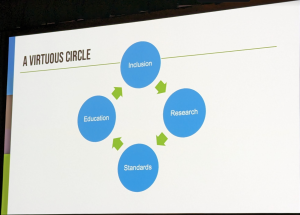
Presentation slide with four circles labeled Inclusion, Research, Standards, and Education, connected by arrows

Versa Press’ Matt Kennell got the day started by introducing a panel consisting of outgoing BISG board director and CEO of IBPA Andrea Fleck-Nisbet, James Miller of Barnes & Noble, and Joshua Tallent from Firebrand Technologies. The panel examined the approach of embracing a Virtuous Circle of Inclusion → Research → Standards → and Education, a theme which echoed across the day’s panels. The discussion touched upon the past Trends publication from BISG, the dozens of webinars and events that are supported each year via BISG’s staff of 2 full-time employees, and the efforts of volunteers on their committees, as well as how BISG continues to work closely with companies throughout the industry to curate virtual and in-person events exploring topics ranging from sustainability to metadata to workflow to rights to subject codes, and more. Lastly, the panel zeroed in on the primary goals for BISG to achieve during the next three years, including:

1. Transforming supply chain communication
2. BISG at 50 (which happens in 2026)
3. Resource development
4. Membership growth
5. Membership retention

The balance of the day saw sessions including:
  • “The Case for Royalty Statement Standards”, moderated by Kris Kliemann from Kliemann and Company, outlining the need for standards on royalty statements in the industry. Panelists included Jennifer Weltz (President, Association of American Literary Agents; President, Jean V. Naggar Literary Agency Inc.), Lucina Schell (International Rights Manager at University of Chicago Press), and Donna Laing (VP of Royalties and Rights Data Management at Scholastic). For those of us not involved in rights, this was a fantastic education on the challenges with administering rights and royalties with so many segments of the industry reporting back on sales and returns in different formats and with different expectations.
  • Ken Brooks (Amplify Education) moderated the session, “Moving Out of the Tower of Babel: Improving Efficiencies Across the Supply Chain”, featuring speakers Claire Holloway (Manager of Publisher Relations, OCLC), Alan DuBose (Senior VP of Planning & Data Analytics, Books-A-Million), and Jessica Wells (Penguin Random House). The supply chain is a topic a bit more ubiquitous than rights across the industry as we each have a role to play in it regardless of our vocation, and the exploration of issues related to forecasting, leveraging actionable data within different systems in our tech stacks, and identifying shared pain points put this topic into a shared frame of reference for all involved that spurred further discussions at the reception following the meeting. With the absence of one point of data in the US, as Booknet Canada supports within the Canadian market, there are ongoing challenges we’ll be working through with the help of organizations like BISG.  An example query that a unified data set could help answer for market research and planning was “How many copies of The Great Gatsby were sold across all publishers after it went public domain?” Having access to that type of unified data would help publishers make better decisions on whether to expand or adjust plans for certain titles in their public domain editions lists, for instance.  Everyone walked away from this session with a list to think about specific to their portion of a book’s life cycle.
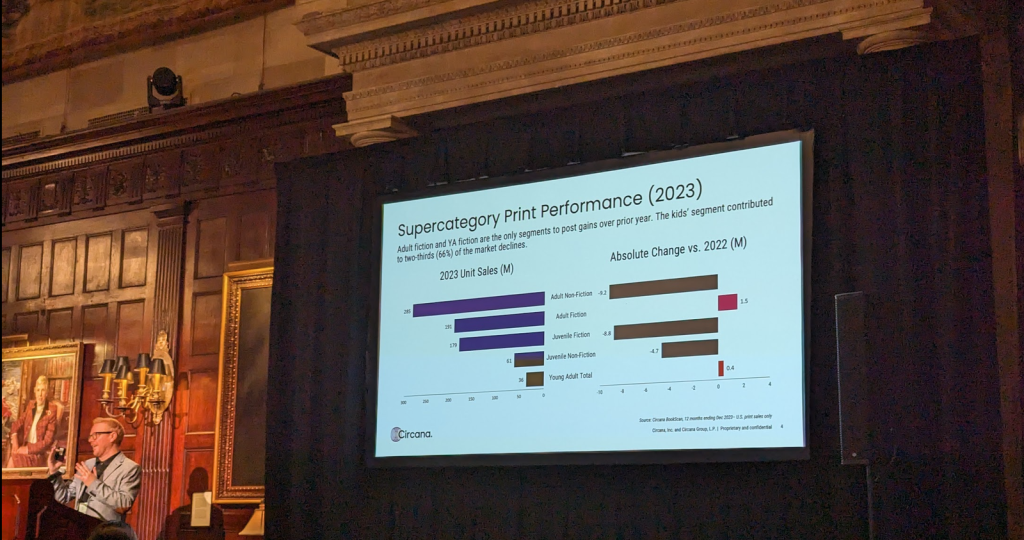
  • Connie Harbison (Baker & Taylor) conducted a “How Standards for Product Metadata Reflect Shifts in Culture” panel discussion with Geraldine Zephirin (Barnes & Noble), Michael Olenick (Clarivate), and Gina Wachtel (Penguin Random House) that looked at the need for standards, and leveraging BISAC Codes more effectively, as well as mapping them to Thema for international markets. The prior interim speech, “Metadata in Action: Understanding Industry Trends” by David Walter of Circana helped illustrate the picture of why clear, consistent metadata is important for helping ensure discoverability and industry tracking that benefits us all.  The panel’s emphasis on the practical – including hygiene tasks for clearing out outdated BISAC codes from your ONIX feed and metadata – made what can be an arcane topic accessible for those of us in the room who may not have a favorite BISAC code (as each panelist shared they did!).
Man speaking from podium at lower left hand corner of picture, with a large presentation screen behind him showing 2023 US Print Book sales figures
David Walter (Circana) discusses 2023 Supercategory Print Sales during BISG 2024 Annual Meeting
After lunch, three awards were presented including The Sally Dedecker Award for Lifetime Service to Phil Ollila of the Ingram Content Group, who was introduced by BISG and Stationers’ Company member Lorraine Shanley, and the BISG Industry Innovator Award presented to Scribd, who was represented by Andrew Weinstein.
Author Walter Mosley addresses the BISG Annual meeting from the podium on the stage in New York City's Harvard Club
Walter Mosley accepting the 2024 Industry Champion Award during the BISG Annual Meeting on April 12, 2024

The 2024 Industry Champion Award was presented to Walter Mosley by Michael Pietsch, CEO of Hachette Book Group and Mosley’s former editor. Mosley received the award not only in recognition for his body of work, but for his founding of the Publishing Certificate Program at City College of New York (CCNY), his alma mater. His efforts in developing an educational program to create awareness of the opportunities in the publishing industry for people of underrepresented backgrounds was the primary topic in his introduction and in his own speech. To Mosley’s credit, he challenged the room to do more than give him an accolade and move on, but to instead follow his example of driving change in the industry by hiring people from different backgrounds and improving the diversity within the companies involved in publishing books, ensuring all voices and audiences are being seen, heard, and properly represented.

Executive Director Brian O’Leary’s closing session – Book Publishing Next: Changes We Want to See in the Industry – marked the first time Brian has given a keynote during his BISG tenure and provided a capstone to the day by walking through how all of the topics introduced earlier (rights, supply chain, subject codes, metadata, inclusion, and more) were the inspiration for the 3 year plan that had been introduced at the start of the day by the board. Brian highlighted how more growth can be achieved through better management of rights opportunities, managing costs, and being more consumer focused. Brian’s consultative approach to the info gathered through surveys and committee meetings leading up to the event hearkened back to a comment Phil Ollila had made earlier in the day, “People like to be engaged, not managed.” By encouraging ongoing engagement with the audience and the volunteers that comprise the bulk of BISG’s momentum, Brian underscored how the industry plays a vital role in making improvements for the continued benefit of everyone within publishing, rather than a one-way keynote closing the day’s sessions.

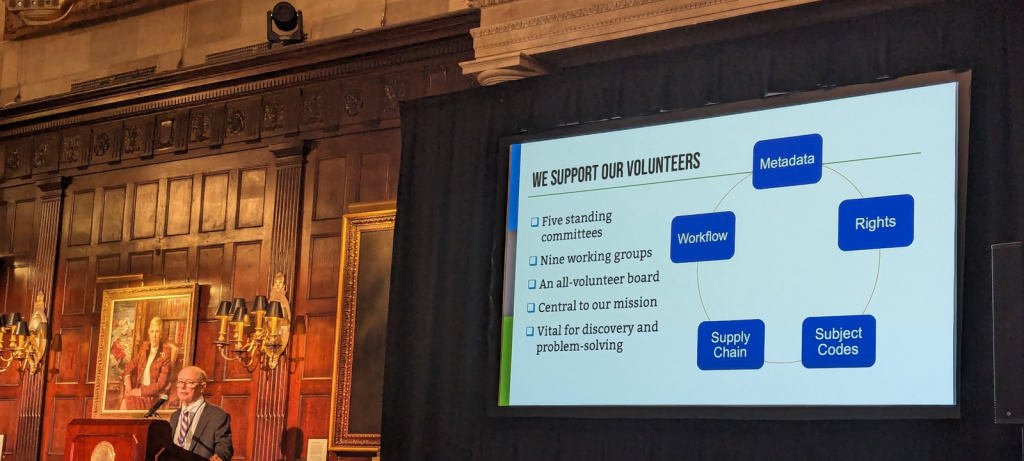
The below image cannot be emphasized enough – the volunteers drawn from all walks of the industry drive the content and mission of BISG, making meaningful events like the annual meeting itself and the ongoing webinars throughout the year possible.

Man standing at a podium with a presentation screen behind him showing squares with words including metadata, workflow, rights, supply chain and subject codes
Brian O’Leary, Executive Director of BISG, delivers closing keynote for the 2024 Annual Meeting
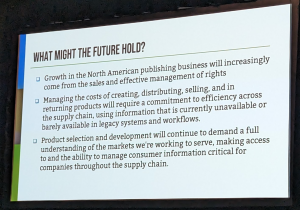
Presentation slide outlining future possibilities for publishing industry in North America
What Does the Future Hold – BISG 2024 Annual Meeting

In closing, what does the future hold? Well, Brian shared a few ideas but in the theme of the day’s session, why not join BISG, attend a committee meeting to contribute your voice to the discussion and help steer publishing’s future? More about BISG membership, which is open to companies and individuals, is available here.

Contact Us at Westchester to talk about highlights from the day, and ways we’re helping BISG member orgs and our hundreds of publisher clients around the world with their workflow challenges.


Filed Under: blog, Conferences, News, Services Tagged With: accessibility, BISAC, BISG, Booknet Canada, committees, discoverability, diversity, efficiency, growth mindset, industry communication, metadata, ONIX, publishing industry, representation, rights, royalties, Stationers' Company, supply chain, Thema, workflow, working groups

March 14, 2024

by Tyler M. Carey, Chief Revenue Officer

Reader note: As of March 2024, the European Accessibility Act is slated to become effective in June, 2025. While there is speculation about a 2030 loophole for backlist content, we strongly recommend you confer with legal counsel for professional guidance.

If you’re trying to figure out what your company needs to do with just over a year from the European Accessibility Act’s (EAA) June 2025 deadline, this blog post is for you.

In March of 2019, the European Accessibility Act was passed, to make arrangements for better support for people of all capabilities and needs across countless products and industries. For publishers, this meant that at a certain point in time any books they had available for sale in Europe would be required to have an accessible alternative version available for anybody with print disabilities, visual challenges, neurodiversity issues, or countless other reasons where they would benefit from consuming a book via an e-reader or adaptive technology.

There were thought leaders who were on the accessibility train long before the EAA, who helped provide guidance to many of us and shared best practices. Publishers like the University of Michigan Press and Macmillan Learning have been providing guidance to their peers on this subject for many years, in conjunction with innovators like Laura Brady and Bill Kasdorf, and organizations like Benetech and DAISY. Westchester realized the import of the EAA on the files we deliver to digital platforms and provide to our clients, so we went through the rigorous process to become Benetech GCA-certified and joined DAISY to bring better resources to the table for our staff and clients.

Many of our clients were also similarly embracing accessibility for these reasons, even if they have not had accessibility baked into their workflow before. But for many publishers – crushed by the surging prices for paper, printing, and shipping during the pandemic – the timing to invest in a new aspect of their workflow was ill-timed. Many well-intended publishers have – for pragmatic reasons – been hitting “snooze” on the monthly calendar reminders they may have that say “Prepare for the European Accessibility Act”.

So, now the alarm has gone off, you’re doing the math and realize waiting is no longer a plausible strategy. What should you do?

  1. Consult Counsel. If you have an attorney on retainer, ask them for their input on how much of your list you have to get converted into accessible, reflowable ePub3 files by July 2025, and if they feel you have wiggle room to delay conversion on any backlist titles
  2. Audit Your Capabilities. Anything front list should be being created as an accessible, reflowable ePub3 file as a rule for moving forward. The rules are a bit more gray on books that are fixed layout (e.g. graphic novels, heavily designed titles), but WCAG, BISG, and other organizations are trying to help set policies for accessible fixed layout titles. If you don’t have possess the in-house chops to create accessible ePubs, find a GCA-certified vendor that Benetech has flagged as being able to provide accessible-compliant files. And yes, – shameless plug alert – US employee-owned Westchester Publishing Services is a leading, GCA-certified vendor with affordable rates for front and backlist conversion. (Contact Us to learn more – but first, finish reading this for more tips.)
  3. Audit Your List. Like tackling any gigantic pile of anything, triage. For your titles in print, which are new and likely to still be selling well in 2025? Which titles in your backlist are perennial sellers, or tied to an upcoming event or release? (e.g. some books about J. Robert Oppenheimer spiked in sales after the release of Christopher Nolan’s blockbuster movie Oppenheimer, last year and will likely see increased activity with the movie winning seven Academy Awards. Your sales lead should be able to help you forecast these things.) Start with remediating the available ePub files for those titles or convert any for which you don’t have ePub files. Any with art are going to need Alt Text (read on)
  4. Audit Your Workflow and identify the Gotchas. While the ACE Checker by DAISY will review your files for anything structural or in the metadata (all key), there are a handful of less easier-to-track areas where ePub files will fail being acceptable as ‘accessible’:

a. If they are not ePub3. ePub2 files will often need to be upgraded or remediated if they do not meet the ePub Accessibility 1.1 spec.
b. If they have art that is missing alt text. Alt text acts as a descriptor for an image that adaptive technology can read aloud for someone to help them understand to help someone better understand what is depicted in the image. There are recommendations about how long the entries have to be, and what they will need to contain. This is a task that can often be taken on by an editorial assistant, copyeditor, or even the author. Vendors like Westchester can write alt text entries as a service, too, of course – and for backlist projects that can often be the most efficient way to pick away at the pile. But look at these resources to give thought to how you can adjust your own author or editorial guidelines moving forward to make this another task or asset for a publication. Top tip: when providing alt text to a vendor, it’s often fairly easy to simply add it to the art log.
c. If they have passages in other languages. If a book has frequent passages in other languages, an editor needs to tag these so that the compositor/converter can flag this in the ePub metadata.
d. If they have charts with red and green elements. Many accessibility requirements tie into common sense changes many of us made in our workflows many years ago. It’s been considered a bad practice for many years to use red and green in tables and charts. Well, now it will prevent an ePub from being sellable as an accessible ePub. If you have books in your backlist where this may be an issue, those tables will need to be re-set for your ePub.

5. Start following thought leaders. Laura Brady posts articles on her site, which is an amazing resource for learning about accessibility, news, and policy. Bill Kasdorf’s site, Publishing Technology Partners, contains perspective and ideas to consider to make accessibility manageable and part of your workflow. DAISY has these resources – and you should consider joining. Benetech not only manages the certification process for publishers and vendors, but they themselves are experts and resources in their own right. These other resources, including a white paper about a webinar hosted by Westchester, featuring Bill Kasdorf’s advice on navigating the EAA, are also helpful.

Like anything else in life, accessibility is a journey not a destination. Contact Us to discuss your accessibility journey and the challenges you’re encountering. Between our editorial, production, and digital resources, Westchester has many ways we can to help you audit your workflow, your titles, and help you draw up a plan. Talk with us about how we can help.

Filed Under: News, Services Tagged With: ACE by Daisy, ACE Checker, adaptive technology, alt text, Benetech, Bill Kasdorf, BISG, DAISY, EAA, Epub3, European Accessibility Act, fixed layout titles, GCA-certified, Laura Brady, metadata, WCAG

March 5, 2024

headshot of Tyler Careyby Tyler M. Carey, Chief Revenue Officer

The team at US employee-owned Westchester Publishing Services are enormously fortunate to work with the hundreds of publishers and content providers around the globe that we support. While we’re always eager to help problem solve our clients’ content, editorial, production, and digital project challenges, we realize that we don’t exist in a bubble. Our portion of the publication life cycle is a crucial piece to ensuring quality in publications and digital content – but plenty of other organizations play key roles beyond us and the publishers we serve. Westchester’s meetings during January and February reinforced this, as our paths crossed with a number of our key partners and organizations that provide further support to our clients.

January saw me meeting with the head of the City of London’s Stationers’ Company during his visit out to meet with North American members in New York City. Tony Mash is a rarity in the world of British livery companies, as he is a dual US/UK citizen, providing leadership to what is essentially an extension of London’s guild system. The Stationers’ Company plays a key role as a leading organization for the content and media industries, hosting frequent in-person and virtual events to let thought leaders in areas of our industries as varied as journalists, pen manufacturers, publishers, and intellectual property attorneys explore topics that affect our industries through an interdisciplinary lens. The North American members will be hosting an upcoming webinar about the transatlantic IP implications of the use of AI within the publishing industry. Additional details and registration information can be found using this link.

To Tony’s credit, by leveraging his US and UK perspectives, he has helped grow the North American contingent of the Company to a few dozen active participants from all areas of publishing and media. More about the Stationers’ Company and how to join can be found on their site.

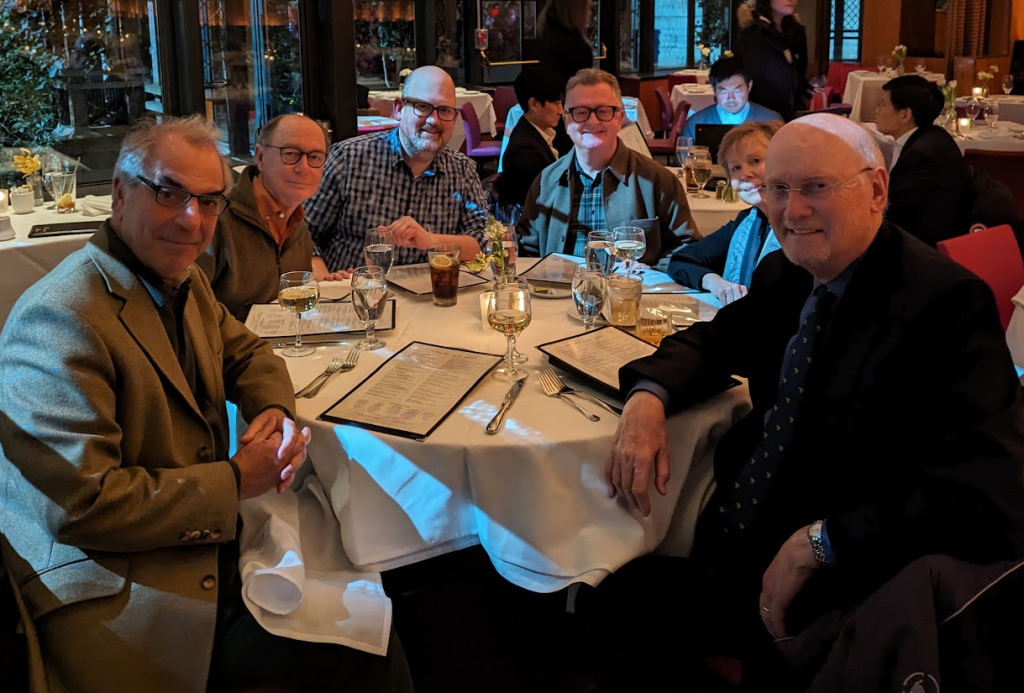
Six people seated around a circular table topped with menus, plates, silverware, and drinks.
Stationers and colleagues: Roger Rosen, Brian O’Leary, Tyler M. Carey, Michael Healy, Lorraine Shanley, and Tony Mash.

During the above get together, I also had a chance to visit with the Book Industry Study Group’s Executive Director, Brian O’Leary. Brian was excited to discuss this year’s BISG Annual Meeting, being held on April 12th in New York. This event routinely presents excellent panels and discussions around the industry’s pressing issues. Perhaps even more rewarding is the opportunity to meet and network with a wide array of publishing professionals who work in many areas of our industry, allowing us to meet vendors, publishers, and partners with which we might not typically interact on a regular basis. I highly recommend checking out the day’s agenda and signing up.

The late Winter also saw visits Deb Taylor (Westchester’s COO) and I made to our partners at Ingram and Dropbox. Ingram graciously hosted us for a meeting about our ongoing work together to support their publishers and authors with ePub conversion services and other capabilities. As part of our trip out to LaVergne, TN, we had an opportunity to tour Ingram’s Print on Demand facility, seeing the continually improving capabilities available to help publishers and self-published authors take a book from digital files – like the ones we create for our clients – at one end of their facility to shipping printed books off to consumers at the other end of the facility in lightning fast time. LightningSource has earned its moniker, for sure.

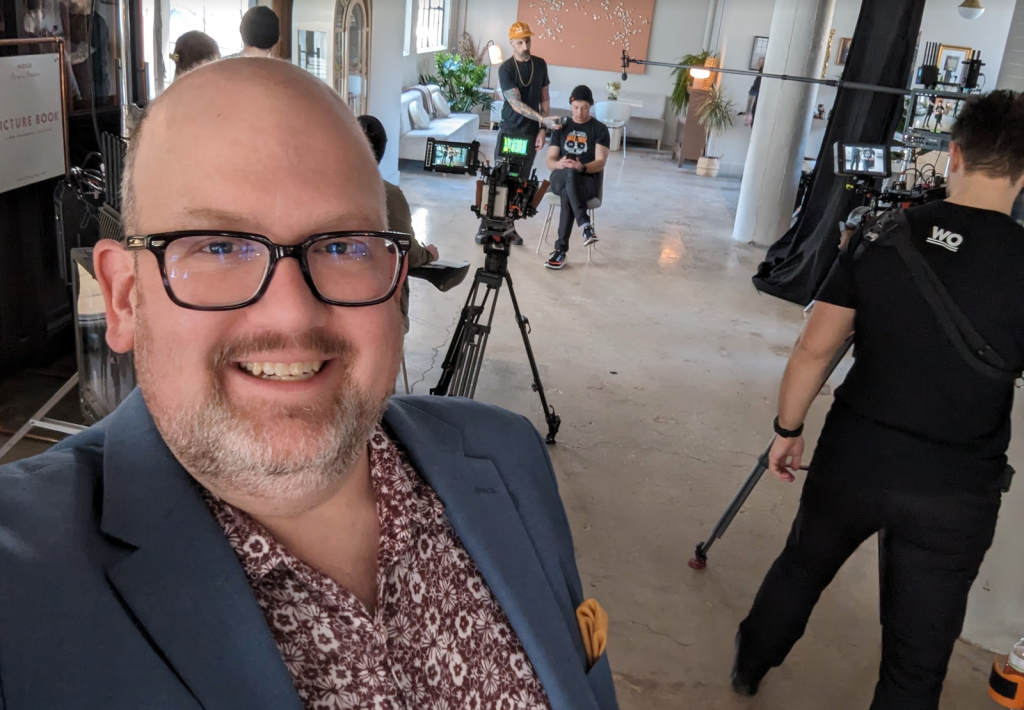
Our colleagues at Dropbox hosted me and Deb for an afternoon to talk about Westchester’s use of Dropbox’s API as part of our Client Portal, which makes publishers’ lives super easy by allowing them to transmit files to Westchester, and then track their projects at each stage. Westchester further uses Dropbox Paper for documenting our clients’ style guides and requirements, DocSend for marketing, Dropbox Sign for client contracts, and many more pieces of the Dropbox ecosystem. During our visit, we got to sit in for interviews and discussions that were filmed for an upcoming project. Stay tuned for this short digital film, this Spring.

bearded man wearing glasses, burgundy floral shirt and blue blazer with handkerchief in the breast pocket. Behind him are a film crew preparing to do a video shoot.

Other partners and organizations with shared interests in the publishing industry came up in many more discussions with our clients during the late winter.

  • One legal publisher was seeking out a partner to help with content development on an anniversary publication, so we were able to connect them with the talented Linda Secondari at Studiolo Secondari to explore her team’s writing and photo capabilities, to help them realize their vision for a 4-color tribute book that differs from their typical legal publications.
  • In discussions with another publisher about BISAC codes and THEMA codes, we were able to point them to our friends at the Book Industry Study Group, which provides guidance and tools to support this kind of mapping.
  • Another partner of ours was looking for a speaker on accessibility to help educate their clients about the European Accessibility Act, so we were able to connect them with the leadership at Benetech to arrange a webinar on this topic.
  • And another publisher was looking to repurpose books from their backlist, seeking to scan them, extract text, and chunk that text into a content management system for digital research. Through our own capabilities and those of our scanning partner, we were able to help them scope and execute on this plan.

Westchester is one individual provider within the overall publishing ecosystem, but due to the hundreds of publishers we work with and our shared industry networks, we’re able to help connect our clients with other trusted partners that can help solve problems that overlap or are adjacent to the work that we do.

Contact Us to talk about your publishing challenges, vision, and plans. Westchester is happy to explore our core competencies in content development, editorial, production, and digital. But, if your needs require something outside of our capabilities, we will be quick to say so and recommend a partner who could help. Solving problems and building relationships within the publishing community is what we do best. Reach out today and let us know what problems we can solve for you.

Filed Under: blog, Featured, News, Services Tagged With: API, BISG, BISG Annual Meeting, Book Industry Study Group, Client Portal, content development, digital solutions, Dropbox, ecosystem, editorial, Ingram, LightningSource, Production, publishers, publishing, Stationers' Company, Studiolo Secondari

December 18, 2023

headshot of Tyler Careyby Tyler M. Carey, Chief Revenue Officer

For the past few years, getting together at the end of the year to celebrate as we typically did pre-pandemic was challenging for a lot of folks for obvious reasons. Even last year, as I attempted to put together a small focus group meeting in mid-December for one of the markets we serve, I found that the 2021 Omicron surge was still front of mind for a lot of New Yorkers and we had a lot of last minute cancellations. All of this was completely understandable for everyone’s own decisions about their situation and the safety of themselves and their loved ones.

So, it was a refreshing, welcome opportunity to attend a packed house event hosted by the New York Book Forum on December 13, gathering together publishers, manufacturers, vendors, and other publishing thought leaders for some end of year conviviality in midtown Manhattan. I had the opportunity to reconnect with customers and vendors I had not seen in person since before the pandemic, and the old habit of trading business cards was even back for some of us.

I have to give the leadership of the New York Book Forum a lot of credit for filling the void from the former BIGNY, which in many ways was its precursor organization. The need for regional networking organizations for the publishing industry is even more important now due to the ways the industry has changed over the past few years in response to supply chain issues, increasing costs at all stages of a book’s life cycle, and emerging topics like the potential use cases for artificial intelligence in publishing workflows. The Book Forum’s regular events give a voice to publishers and vendors to share their experiences and practices, and I highly recommend checking out their event calendar for 2024 to find ways to participate in person — or virtually, if you’re not regularly in the New York area.

I would be remiss in not highlighting one of the most engaging conversations I had during the evening. The holiday event served as an opportunity for me to catch up in person with the Book Industry Study Group’s Brian O’Leary and Brooke Horn, as well as Linda Secondari of Studiolo Secondari, who played a big role in rebranding and launching BISG’s new website. BISG serves a different role from NYBF for our industry, as a formal trade association that explores topics of interest to our industry which affect segments like workflow, supply chain, and rights. BISG’s upcoming events are also worth exploring, as their committees regularly put out papers and webinars to help provide analysis and best practices that are practical and applicable to publishers of all types. Westchester is very active in the BISG workflow committee, and exploring having stakeholders join other committees to help us learn more and participate in discussions around different aspects of our clients’ work.

If you’re a regular reader of this blog, you likely received an email from us thanking you for your interest in 2023 and sharing that we have once again made an annual gift to the Connecticut Food Bank, which is part of the national organization Feeding America. US employee-owned Westchester continues to champion the cause of helping local communities combat food insecurity, and encourages you to join us by supporting a food pantry or charity in your community.

From me and all of the team at Westchester’s offices in the US, UK, and India, we wish you the happiest of holidays. When you’re back in January, let us know what we can do to help you in the new year by using the Contact Us link at the bottom of this page.

Filed Under: blog, Conferences, News, Services Tagged With: analysis, best practices, BISG, committees, discussion groups, industry events, New York Book Forum, publishers, publishing industry, stakeholders, supply chain, trade association, workflow committee

October 13, 2023

Discussing the Westchester Publishing Services Client Portal

by Tyler M. Carey, Chief Revenue Officer

This week’s Dropbox Work in Progress conference in New York City was exciting whether you are a Dropbox power user or not. Topics covered included the new normal of what workplaces and productivity look like, supporting clients and staff with the right tools to get work done as well as communicate more effectively, and — threaded through pretty much every session and panel — the impact of AI on work itself. I was fortunate enough to participate in two back to back editions of a panel called “Scaling Success: the role of automation and collaboration in business growth.” More on what I shared there about our Client Portal, but let’s talk about what the overarching message of the day was, first.

Image of Drew Houston, CEO of Dropbox standing on a stage in front of a screen with the words Global Pandemic and Economic Uncertainty on the left and the words Flexible work and AI revolution on the right.
Drew Houston keynote speech, Dropbox Work in Progress Conference, October 10, 2023

The keynote by Dropbox CEO Drew Houston sets the table for a discussion all companies should have on an ongoing basis about how work is handled in a post-pandemic world, how we are supporting our team members, and how new tools — including AI — can be used to add to productivity when used with the right level of trust and responsibility.

Houston’s keynote is a must watch, and set the tone for the day. To cherry pick another highlight, I would also point to comments by one of the later panelists — John Horton, Associate Professor at MIT Sloan School of Management — who emphasized how AI benefits us most when paired with human beings to apply their judgment and selectively apply what AI can output, rather than just use AI output and guidance without consideration. That is right in line with how the best companies are using AI as a tool, rather than replacing proven expertise. Westchester, for instance, will never just dump a manuscript into an engine for copyediting – that negates the expertise we bring to every project. But, just like how our indexers using indexing software to create lists of terms, or we use NLP to create lists of keywords for marketing, it’s worth looking at what tools can help our editors, typesetters, sales people, and more with using their skills effectively.

Image of man standing on a stage in front of a screen displaying learning points
Drew Houston, Dropbox Work in Progress Conference, October 10, 2023

Lest it be thought that the day’s content was just a one-time event-driven theme, it’s clear to see that Dropbox’s approach to making work easier – not just designing a strong file sharing and productivity platform – is baked into everything Dropbox does and communicates, right now. An op-ed in this week’s Independent (UK) by Dropbox’s Andy Wilson elaborates on the company’s approach to work – with an emphasis on finding ways to help users find info they need and avoid the constant distractions of email messages, Slack notifications, and other attention grabbers that, according to data cited in the article, eat up a typical 131 hours of each employee’s work time each year. You may remember Andy from our Work from Home webinar in March 2020, where he – in the thick of the initial pandemic lockdown – spoke about productivity and tools – and continues to share insights and solutions to this day. Andy will be co-presenting with me and Westchester’s COO, Deb Taylor, at the upcoming Digital Book World in January in NYC on just this, once again!

Picture of two women and a man seated on stage with a banner reading Perspectives behind their chairs.
Debbie McClure, Tyler Carey, and Darci Kendall. Photo provided by Dropbox

I was excited to join Debbie McClure, Dropbox’s Global Head of Sales, and Darci Kendall, Founder of Hodde Bros Beverage Co, on the two back-to-back sessions for our panel called “Scaling success: the role of automation and collaboration in business growth.” Debbie moderated the panel asking us questions about our businesses, our tech stack, the opportunities with AI (which I talked about in a recent blog post), and how we grow our businesses – and make our client experience better – by using different tools. Darci provided a lot of great examples of how she uses different channels to engage with her clients, and how she has grown from a small start up ten years ago into a top brand for the beverage and events industries. If your firm is a start up looking to grow, I really encourage you to look up the story of Hodde Bros Beverage Co and learn more.

So, why is Westchester’s story relevant enough to this topic that I was asked to come speak in these sessions at the event? Well, here’s an overview of what I shared during the panel, in narrative form.

Not long after Westchester became an employee-owned company in 2014, Westchester’s managers began highlighting areas where we could focus on a better client experience, as well as ways to grow our company. Our client experience at the time was in some ways fragmented, client by client. On one-hand, this was a bespoke solution for our clients — each client’s own workflow was tailored to, and supported as essentially its own unit here. But that worked well, for both us and our clients, when we had only forty clients to support, and most of those clients had one major line of work with us. But, as we started doing more work across organizations, we found that maybe one department liked to send us files via FTP en masse for typesetting and ePub conversion, and another department was essentially a smaller operation within the same firm that sent individual projects via WeTransfer for editorial and typesetting – and had wholly different style guidelines, schedules, and expectations. And as we moved into new markets back then — like the work we do for think tanks, legal publishers, trade associations, and more — we found that different types of clients had different needs and expectations for file transfer, schedules, communications, project involvement, and services.

To scale, Westchester needed a partner. After vetting many platforms, we selected Dropbox as our partner for file exchange and storage (to start). Clients could still send and receive files via FTP, WeTransfer, Box, Google Drive, what have you, but by setting up a number of processes on our end that talked to those different systems and pulled files into a central cloud-based Dropbox environment, we created efficiencies for us and for our clients.

And wow, did things grow from there! Dropbox was highly consultative, and our team identified use cases with the Dropbox API that let us build a custom project management system using our development team, and sitting on top of a trusted brand by using the Dropbox API for automations and process management, which expedited file transfer and made for a robust client experience. You’ve heard me talk about this in past blog posts, but this was the launch of our Client Portal. The Client Portal allows for easy transfer of files to Westchester via whatever means are best for you — but optimized for easy drop-off using Dropbox, even if you don’t have an enterprise account. No longer did clients have to log into a server, download assets, pass them to an author, gather those files back, upload them again… Steps like that became more automated and lightning fast.

Throughout each project, our clients can see the status of assets at each phase, download assets using downloadable links, and track the project schedule against milestones. None of these features, reports, or options for exchange replace the human interaction and customer care that Westchester is known for — we are just providing added transparency and options for engaging with your project’s assets. This has made for a great experience for our clients and has helped us scale our company as we have added more services and clients, growing from the forty-odd we had in the US back in 2014 to nearly 600 clients around the globe, today.

Beyond the Client Portal, Dropbox opened up its platform to us so that we could use more of their tools, including Dropbox Paper (which we use for many things including tracking client documentation, collaborating on marketing pieces, and planning projects), Dropbox Sign (which we use for contracts and onboarding clients within certain units of our company), DocSend (which we use for maintaining a library of marketing collateral for our sales and marketing teams to engage with clients and prospects about meaningful, relevant case studies), Dropbox Capture (which helps with internal training and other use cases for sharing content with narration), and more. Dropbox has been a phenomenal partner, and we rely on their platform, products, experience, consultation, innovation, and highly regarded security as a key element of not just our tech stack, but also how we support our staff and our clients.

While I’m excited about our above use cases that I shared on the panel — as well as further discussions we had about AI, marketing, and client engagement — that’s not the end of the story. We continue to have very detailed workflow conversations with dozens of accounts each week – both existing partners looking to address new products or challenges, as well as exploratory discussions with new, potential clients. Our editorial, production, and digital services are a cornerstone to the workflows for our nearly 600 clients around the world for a reason, and the blend of people skills and technology we are known for is key to their success. If you are a publisher, the chances are very good that we have had to solve any of the editorial or production challenges that you are currently facing. Contact Us to discuss your needs, and explore ways that US employee-owned Westchester Publishing Services can help.

Filed Under: blog, Conferences, News, Services Tagged With: AI, API, automation, client documentation, client engagement, Client Portal, client support, collaboration, conference, digital conversion services, Dropbox, editorial services, file exchange, production services, secure storage, technology platform, technology solutions, work in progress

  • « Go to Previous Page
  • Page 1
  • Page 2
  • Page 3
  • Page 4
  • Page 5
  • Interim pages omitted …
  • Page 15
  • Go to Next Page »

Footer

We’re ready to help you!     Contact Us   Call +1 203-658-6581

About Us  |  Conferences  |  Press  |  Blog |  Careers  | Privacy Policy |  Education Services  |  Westchester UK
  • Email
  • LinkedIn
  • YouTube

Copyright © 2026 Westchester Publishing Services, LLC.

This website uses cookies to analyze traffic, improve your visit and to help us communicate more effectively with you. Our privacy policy has new information.   Accept Read Privacy Policy
Privacy & Cookies Policy

Privacy Overview

This website uses cookies to improve your experience while you navigate through the website. Out of these, the cookies that are categorized as necessary are stored on your browser as they are essential for the working of basic functionalities of the website. We also use third-party cookies that help us analyze and understand how you use this website. These cookies will be stored in your browser only with your consent. You also have the option to opt-out of these cookies. But opting out of some of these cookies may affect your browsing experience.
Necessary
Always Enabled
Necessary cookies are absolutely essential for the website to function properly. This category only includes cookies that ensures basic functionalities and security features of the website. These cookies do not store any personal information.
Non-necessary
Any cookies that may not be particularly necessary for the website to function and is used specifically to collect user personal data via analytics, ads, other embedded contents are termed as non-necessary cookies. It is mandatory to procure user consent prior to running these cookies on your website.
SAVE & ACCEPT