• Blog
  • Podcast
    • Publishing Fact or Fiction: Getting Ready for ADA Title II – Podcast
    • Westchester Words – All Episodes
  • WEBINARS
    • Publishing Now Fall ’25 – Manuscript to Market
    • Publishing Now Fall ’24 webinar
    • Publishing Now Spring ’24 webinar
    • Publishing Now Fall ’23 webinar
    • Publishing Now Spring ’23 webinar
    • Publishing Now Fall ’22 webinar
    • Publishing Now Spring ’22 webinar
    • Publishing Now Fall ’21 webinar
    • Publishing Now Spring ’21 webinar
    • Publishing Now Summer ’20 webinar
  • About Us
    • Meet Our Team
    • Press
    • How Westchester Helps Publishers
    • Markets We Serve
    • Our Clients
    • Client Testimonials
    • Our Partner Network
    • Our Workflows
    • Conferences & Events
    • Publishers Weekly Special Report-Prepress Services
    • Careers
  • Contact Us
  • PORTAL LOGIN
  • Skip to main content
  • Skip to footer

Westchester Publishing Services

Excellence Delivered

  • Composition Services
    • Sustainable Typesetting®
    • U.S. Serviced Typesetting
    • Offshore Typesetting
    • LaTeX Typesetting
    • Pre-Edit Service
    • ePubs and Digital Conversion
    • Digitally Accessible Content Resources
  • Editorial Services
    • Domestic Editorial Project Management
    • Offshore Editorial Project Management
    • Art and Design
  • Client Portal
  • Westchester UK
    • Education – UK & International
    • Publishing – UK
  • Education Services

Dropbox Work in Progress Conference

News

October 13, 2023

Discussing the Westchester Publishing Services Client Portal

by Tyler M. Carey, Chief Revenue Officer

This week’s Dropbox Work in Progress conference in New York City was exciting whether you are a Dropbox power user or not. Topics covered included the new normal of what workplaces and productivity look like, supporting clients and staff with the right tools to get work done as well as communicate more effectively, and — threaded through pretty much every session and panel — the impact of AI on work itself. I was fortunate enough to participate in two back to back editions of a panel called “Scaling Success: the role of automation and collaboration in business growth.” More on what I shared there about our Client Portal, but let’s talk about what the overarching message of the day was, first.
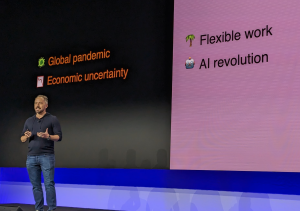
Image of Drew Houston, CEO of Dropbox standing on a stage in front of a screen with the words Global Pandemic and Economic Uncertainty on the left and the words Flexible work and AI revolution on the right.
Drew Houston keynote speech, Dropbox Work in Progress Conference, October 10, 2023

The keynote by Dropbox CEO Drew Houston sets the table for a discussion all companies should have on an ongoing basis about how work is handled in a post-pandemic world, how we are supporting our team members, and how new tools — including AI — can be used to add to productivity when used with the right level of trust and responsibility.

Houston’s keynote is a must watch, and set the tone for the day. To cherry pick another highlight, I would also point to comments by one of the later panelists — John Horton, Associate Professor at MIT Sloan School of Management — who emphasized how AI benefits us most when paired with human beings to apply their judgment and selectively apply what AI can output, rather than just use AI output and guidance without consideration. That is right in line with how the best companies are using AI as a tool, rather than replacing proven expertise. Westchester, for instance, will never just dump a manuscript into an engine for copyediting – that negates the expertise we bring to every project. But, just like how our indexers using indexing software to create lists of terms, or we use NLP to create lists of keywords for marketing, it’s worth looking at what tools can help our editors, typesetters, sales people, and more with using their skills effectively.
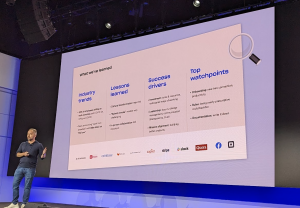
Image of man standing on a stage in front of a screen displaying learning points
Drew Houston, Dropbox Work in Progress Conference, October 10, 2023

Lest it be thought that the day’s content was just a one-time event-driven theme, it’s clear to see that Dropbox’s approach to making work easier – not just designing a strong file sharing and productivity platform – is baked into everything Dropbox does and communicates, right now. An op-ed in this week’s Independent (UK) by Dropbox’s Andy Wilson elaborates on the company’s approach to work – with an emphasis on finding ways to help users find info they need and avoid the constant distractions of email messages, Slack notifications, and other attention grabbers that, according to data cited in the article, eat up a typical 131 hours of each employee’s work time each year. You may remember Andy from our Work from Home webinar in March 2020, where he – in the thick of the initial pandemic lockdown – spoke about productivity and tools – and continues to share insights and solutions to this day. Andy will be co-presenting with me and Westchester’s COO, Deb Taylor, at the upcoming Digital Book World in January in NYC on just this, once again!
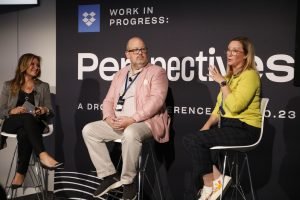
Picture of two women and a man seated on stage with a banner reading Perspectives behind their chairs.
Debbie McClure, Tyler Carey, and Darci Kendall. Photo provided by Dropbox

I was excited to join Debbie McClure, Dropbox’s Global Head of Sales, and Darci Kendall, Founder of Hodde Bros Beverage Co, on the two back-to-back sessions for our panel called “Scaling success: the role of automation and collaboration in business growth.” Debbie moderated the panel asking us questions about our businesses, our tech stack, the opportunities with AI (which I talked about in a recent blog post), and how we grow our businesses – and make our client experience better – by using different tools. Darci provided a lot of great examples of how she uses different channels to engage with her clients, and how she has grown from a small start up ten years ago into a top brand for the beverage and events industries. If your firm is a start up looking to grow, I really encourage you to look up the story of Hodde Bros Beverage Co and learn more.

So, why is Westchester’s story relevant enough to this topic that I was asked to come speak in these sessions at the event? Well, here’s an overview of what I shared during the panel, in narrative form.

Not long after Westchester became an employee-owned company in 2014, Westchester’s managers began highlighting areas where we could focus on a better client experience, as well as ways to grow our company. Our client experience at the time was in some ways fragmented, client by client. On one-hand, this was a bespoke solution for our clients — each client’s own workflow was tailored to, and supported as essentially its own unit here. But that worked well, for both us and our clients, when we had only forty clients to support, and most of those clients had one major line of work with us. But, as we started doing more work across organizations, we found that maybe one department liked to send us files via FTP en masse for typesetting and ePub conversion, and another department was essentially a smaller operation within the same firm that sent individual projects via WeTransfer for editorial and typesetting – and had wholly different style guidelines, schedules, and expectations. And as we moved into new markets back then — like the work we do for think tanks, legal publishers, trade associations, and more — we found that different types of clients had different needs and expectations for file transfer, schedules, communications, project involvement, and services.

To scale, Westchester needed a partner. After vetting many platforms, we selected Dropbox as our partner for file exchange and storage (to start). Clients could still send and receive files via FTP, WeTransfer, Box, Google Drive, what have you, but by setting up a number of processes on our end that talked to those different systems and pulled files into a central cloud-based Dropbox environment, we created efficiencies for us and for our clients.

And wow, did things grow from there! Dropbox was highly consultative, and our team identified use cases with the Dropbox API that let us build a custom project management system using our development team, and sitting on top of a trusted brand by using the Dropbox API for automations and process management, which expedited file transfer and made for a robust client experience. You’ve heard me talk about this in past blog posts, but this was the launch of our Client Portal. The Client Portal allows for easy transfer of files to Westchester via whatever means are best for you — but optimized for easy drop-off using Dropbox, even if you don’t have an enterprise account. No longer did clients have to log into a server, download assets, pass them to an author, gather those files back, upload them again… Steps like that became more automated and lightning fast.

Throughout each project, our clients can see the status of assets at each phase, download assets using downloadable links, and track the project schedule against milestones. None of these features, reports, or options for exchange replace the human interaction and customer care that Westchester is known for — we are just providing added transparency and options for engaging with your project’s assets. This has made for a great experience for our clients and has helped us scale our company as we have added more services and clients, growing from the forty-odd we had in the US back in 2014 to nearly 600 clients around the globe, today.

Beyond the Client Portal, Dropbox opened up its platform to us so that we could use more of their tools, including Dropbox Paper (which we use for many things including tracking client documentation, collaborating on marketing pieces, and planning projects), Dropbox Sign (which we use for contracts and onboarding clients within certain units of our company), DocSend (which we use for maintaining a library of marketing collateral for our sales and marketing teams to engage with clients and prospects about meaningful, relevant case studies), Dropbox Capture (which helps with internal training and other use cases for sharing content with narration), and more. Dropbox has been a phenomenal partner, and we rely on their platform, products, experience, consultation, innovation, and highly regarded security as a key element of not just our tech stack, but also how we support our staff and our clients.

While I’m excited about our above use cases that I shared on the panel — as well as further discussions we had about AI, marketing, and client engagement — that’s not the end of the story. We continue to have very detailed workflow conversations with dozens of accounts each week – both existing partners looking to address new products or challenges, as well as exploratory discussions with new, potential clients. Our editorial, production, and digital services are a cornerstone to the workflows for our nearly 600 clients around the world for a reason, and the blend of people skills and technology we are known for is key to their success. If you are a publisher, the chances are very good that we have had to solve any of the editorial or production challenges that you are currently facing. Contact Us to discuss your needs, and explore ways that US employee-owned Westchester Publishing Services can help.

Filed Under: blog, Conferences, News, Services Tagged With: AI, API, automation, client documentation, client engagement, Client Portal, client support, collaboration, conference, digital conversion services, Dropbox, editorial services, file exchange, production services, secure storage, technology platform, technology solutions, work in progress

October 9, 2023

by Hugh Shiebler, Director, Client Solutions

Hugh ShieblerAs Alvin Toffler wrote over fifty years ago, “The illiterate of the 21st century will not be those who cannot read and write, but those who cannot learn, unlearn, and relearn.” The ever-quickening pace of change – and the necessity of adapting to that change – was a main theme of the New Directions in Scholarly Publishing Seminar, held October 4-5, 2023 and hosted by the Society for Scholarly Publishing. I attended both days of this year’s seminar, titled “Navigating the Shifting Sands: Managing Disruptions in Scholarly Communications.” The timeliness and depth of the presentations was matched by the quality of the questions asked, resulting in a lively dialogue.
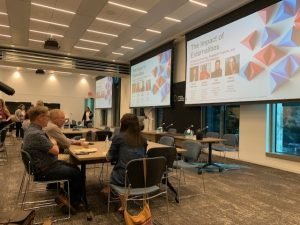
picture of Society of Scholarly Publishing conference attendees sitting at tables in a conference room, looking at pulldown screens containing information about a session topic.Discussions about artificial intelligence (AI) threaded through most of the presentations. Sessions such as “New Directions in Research Integrity: Values to Value in Research Publishing” and “Authorship in the Age of AI” emphasized embracing new technologies as tools without compromising one’s values or losing touch with the human elements that make scholarly publishing what it is. Dr. Rebecca Brendel, the Director of the Center for Bioethics at Harvard Medical School, delivered the keynote address, “New Directions in Research Integrity: Values to Value in Research and Publishing.” Dr. Brendel reminded all of us that integrity in research depends upon the integrity of individual researchers, administrators, and publishers. And, that core values such as honesty and transparency will be even more critical as AI continues to pervade the research and publication processes. Following the keynote address, Simone Taylor, the Publisher of the American Psychiatric Association, moderated a discussion with Dr. Brendel.

You may have seen our recent blog post on AI or my colleague’s appearance on a recent podcast discussing our view on how to integrate it into publishing workflows. We’re excited about the potential to continue expanding our offerings and ways we can help publishers.

Filed Under: blog, Conferences, News Tagged With: academic publishing, AI, artificial intelligence, conference, publishing, research, scholarly publishing, Society for Scholarly Publishing, SSP

October 4, 2023

by Tyler M. Carey, Chief Revenue Officer

headshot of Tyler Carey2023 has been another busy year here at US employee-owned Westchester Publishing Services, as we continue to expand our stateside and offshore operations to further support our clients’ editorial and production needs. In addition to our standard editorial and production work, we are supporting numerous clients who are expressing increased interest in scanning backlist titles, print-on-demand file requirements, accessible ePubs, developmental editing, permissions, and author support tasks.  Across our global operations based in the US, UK, and India, we now support approximately 600 clients around the world. We appreciate the feedback from these partners that has helped us better understand how we can work with publishers and content providers to resolve their problems and deliver quality publications to their readers. 

To best support both client growth and the additional services we are providing, we announced two promotions earlier this Summer.  Deb Taylor has been promoted to our Chief Operations Officer, and Christober Masilamani has been promoted to our Managing Director for our Chennai, India production operation.  More information about their new roles can be found in this press release.  Let me know if a discussion with Deb or Christober about incorporating your needs into our plans and direction would be helpful. You can Contact Us anytime to schedule a discussion with your sales point of contact and our leadership team. 

We enjoy having an ongoing dialogue with the market about topics impacting our industry. Here are a few discussions that may be of interest to you: 

  • Last month, I spoke on the Publisher Nation podcast with Digital Book World’s Bradley Metrock – and industry thought leaders Lorraine Shanley (Market Partners International) and Andrea Chambers (NYU Masters in Publishing) – about how publishers are exploring AI within their workflows. You can watch the YouTube feed of our discussion. 
  • On October 10th, I will be presenting on the “Amplifying Impact” panel at Dropbox’s Work in Progress conference in New York City. I’ll be speaking about how we partnered with Dropbox to build out our Client Portal, and how both of our organizations continue to explore ways publishers and media organizations can leverage tools and technology to make their work more efficient.  You can sign up for this one-day event on Dropbox’s site. I’ll also share a blog post afterwards with info about the day’s content and any best practices that may be worth tracking. 
  • Most exciting of all, our next Publishing Now webinar – launched in partnership with Publishers Weekly – is coming up on Thursday, October 26th.  Speakers include Marina Padakis Lowry from Union Square & Co., Diem Bloom from Johns Hopkins University Press, and Bill Rojack from Midland Paper and Two Sides North America. Our panelists will be exploring the ways books are being produced in our new normal, including topics related to AI, workflow, and working with partners. You can sign up here. 

If there are any areas where you have questions, contact us to schedule a brief Zoom. We always like to help, even if that means connecting you with our partners who may be better able to support those needs that are outside our area of expertise. I would welcome the chance to hear from you, and learn more about what you’re exploring with your 2024 publications program. 

Filed Under: blog, Conferences, News, Services Tagged With: accessible ePubs, AI, Client Portal, collaboration, developmental editing, Dropbox conference, editorial, epub, Johns Hopkins University Press, Midland Paper, print on demand, Production, Publishers Nation podcast, Publishing Now webinar, scanning titles, Union Square and Co., workflows

January 23, 2023

by Tyler M. Carey, Chief Revenue Officer

It has been longer than I would have liked since I last shared a post-conference blog post. I am glad that NYC’s Digital Book World (DBW), held January 16-18 at the Sheraton on Seventh Avenue, afforded me the opportunity to reconnect in person with many of Westchester’s partners and those of our clients who were able to make the trip to New York for the meeting.

As noted by Lorraine Shanley in her coverage of DBW in MPI’s Publishing Trends newsletter, the attendance was a bit upside down with far more vendor and industry types than publishers, it appeared. That said, the panels presented provided more than a little food for thought on topics ranging from the role of AI in publishing, to how to market books effectively online in the current landscape, to where we’re all headed as an industry.

Screenshot from keynote speechIt was on that latter topic that Margot Atwell, the executive director and publisher of The Feminist Press, provided an insightful session. She revisited a presentation she had shared at London Book Fair in 2019, in which she had identified a number of trend lines in the industry – including equity, consolidation, and the financial health of the industry – and updated her analysis and predictions for 2023. Whether you were representing a vendor, a large publisher, or a start up, her insights on how to foster equity, continue to adapt to a distributed workplace, and navigate the financial and societal challenges in our industry resonated.

Aligned with another one of Westchester’s core principles was the panel on accessibility hosted by Bill Kasdorf, who was a panelist on our September 2022 webinar about accessibility and sustainability. Joining Bill were Michael Johnson from Benetech, Madeleine Rothberg from WGBH, and Richard Orme from the DAISY Consortium. As a Benetech GCA-certified partner, Westchester is keen to help amplify the messaging around not just the needs for accessibility but also the best practices that publishers can adapt into their workflows. Each panelist shared a headline and several discussion points with one another to help further discussion about the needs for publishers to accelerate their adaptation to support readers requiring accessible content. As the coverage of Day 1 of the conference in Publishers Weekly emphasized, Michael Johnson laid out numerous examples of the prevalence within the population of individuals who need or use adaptive technology to consume content. With an estimated 20% of the world’s population having a need, this isn’t a nice to have, it’s a necessity for ensuring as many readers can consume your content as possible.

Bill Kasdorf put perhaps the finest point on the subject by pointing out that due to the European Accessibility Act, if you plan on selling any ePub content in Europe by 2025, that content has to be created accessible or converted to accessibity standards – including backlist content – or it will be illegal to sell within the EU. But, to the point of everyone on the panel, that doesn’t necessarily mean a gigantic investment of resources or a total revision to how you create content. Micromoves internally and with partners can help pick away at the pile quickly and affordably. One key topic that seems to frustrate many publishers is that of alt text. While there are commonly accepted practices, the ‘right’ alt text is not codified the way that say metadata rules might be. As Michael Johnson pointed out, the same image could have different tags depending on its use. An image of the Eiffel Tower in a cookbook about crepes may be ornamental – not relevant to how to make a crepe – so it could just be labeled as “Ornamental” in its alt text entry. In a book about Paris, perhaps a few brief sentences describing the image of the Eiffel Tower would be appropriate. In an engineering book, the Eiffel Tower image might be being used to augment some content about the tensile strength of steel so a different, brief entry would be called for. But in none of these instances is a thoroughly written, revised, and breathtaking narrative called for – alt text entries are there to tell a reader what is in the image, not replace the content that is already in the text that the image is intended to augment. And to Madeleine Rothberg’s point, there is a metadata field called “Accessibility Summary” in each file that allows you to make notations re: pieces that are works in progress, absent, etc., understanding that there will be exceptions and things that may need further attention after initial creation or conversion. We’re all learning new things regarding accessibility – even those of us who are deeply involved in accessibility – and this field serves as a placeholder to indicate where we think something may need to be revisited.

To help us all navigate the world of accessibility, and better plan for the looming EU deadline referenced above, a number of resources were shared by the panel that Bill Kasdorf consolidated here. I highly encourage you to review these resources and share them with any of your team involved in working with authors, editing content, and producing digital files.

Other excellent sessions included Ingram’s presentation about its Ingram iD platform, which allows for direct-to-consumer marketing, sessions from Scribd and Spotify about different revenue models for content distribution, and sessions from AI firms showing how audiobooks and more can benefit from AI.

Westchester’s Vice President of Business Development and Marketing, Deb Taylor, attended DBW as well, and provided this commentary about ChatGPT coming out of a session hosted by another vendor in our space.

Deb shares:

DBW’s sessions were typically not company/product commercials, although like most conferences, a few did lean that way. When the Trends in Content Creation Using AI and Smart Technology session by PageMajik started, I think most expected it to be a carefully disguised commercial about their services. It turned out to be a micro master class in how to think about AI and, in this case, the “controversial” open source AI, GPT3 (or ChatGPT). Keep in mind, PageMajik wasn’t the only one discussing AI and how it has many places in publishing – we learned about interesting uses of AI in audiobook production workflows, and in the use of synthetic voice, too.

So while ChatGPT has been banned on some school networks due to fear of plagiarism, this session reminded us that this is just technology – clever technology, mind you – but still just technology, and we, as humans can make a choice in terms of how to use and deploy it.
“We can be lazy, or we can be productive. The choice is ours.” And yes, we should be mindful that clever technology like GPT, does need some guardrails so it can be harnessed with positive productivity, not laziness or malintent.

For those who are wondering how ChatGPT can be purposeful in the publishing industry, here are a few thoughts:

1. One potential use case is for content generation, where the model can be trained on a specific topic or writing style, and then used to generate new articles, blog posts, or other written content. Additionally, ChatGPT can be used for editing and proofreading by identifying grammar and style errors in existing text. It can also be used for summarizing long articles or books, creating headlines and summaries for news articles, and even writing personalized responses to readers’ questions or comments. Overall, ChatGPT offers a powerful tool for automating and enhancing various aspects of the publishing process.

2. Another area in the workflow that often requires much back and forth with authors and copyediting teams is the reviewing, checking, and correcting of references and citations. ChatGPT can help with reference citation checking in manuscripts by using natural language processing (NLP) techniques to identify and extract citations from the text. Once the citations have been identified, the model can then compare them to a database of references to ensure that they are accurate and properly formatted. Additionally, ChatGPT can also be trained on specific citation styles, such as MLA or APA, to ensure that the manuscript adheres to the appropriate guidelines. It can also be used to check for missing references or duplicate citations in the manuscript. Overall, ChatGPT can provide a powerful tool for automating the reference citation checking process, which can help to save time and improve the accuracy of the final manuscript.

I’ll leave you with this final disclosure: Both the paragraph on use cases and reference citations were written by ChatGPT, in seconds. Would that be categorized as lazy? No. I believe it was incredibly efficient, however, the best use may be more in the middle. Let ChatGPT be the tool to help you formulate your idea but perhaps not be used verbatim. After all, it’s just technology, and it’s using what it has access to. You still need to validate the information. Try it out for yourself here. And then make sure to ask what its limitations and challenges are.

In general, these new aspects of technology are exciting and ones that we should not be fearful of, but figure out how to use to improve and advance our industry as a whole.

While there was a bit of humor artfully weaved into Book.io’s session, Digital Ownership, NFTs and Revenue Streams for Publishers, there were some interesting things to think about as it relates to the personalized marketing opportunities and the new potential revenue stream that blockchain could offer. eBooks, as we know, are meant to be licenses to the individual to “view, use and display” without any permissions to sell, rent or distribute otherwise. Digital books on the blockchain change that paradigm, and also enable the publisher to experience an ongoing revenue stream from books sold here. Per Book.io, it will increase the intellectual property value of the content. There is also the opportunity for the publisher to direct market the owner since there is more visibility in the digital ownership – think here about gating content with permissions, and even price points to owners vs non-owners. There are efficiencies (multiple languages), interesting design opportunities (different cover designs), unique targeted marketing ideas, and more here. As with all new technology, let’s not dismiss or fear it, but rather let’s get to know and harness it to continue to advance our industry.

—————————————————————————————————————-

Further coverage of DBW 2023 is available in this post from Publishing Perspectives that provides thorough coverage of keynote speaker Karine Pansa’s presentation about her mandate and expectations for her term heading the International Publishers Association, as well as this article from Publishers Weekly highlighting information for publishing start ups.

As always, US employee-owned Westchester Publishing Services is keen to learn more about which portions of your book production workflow you are navigating, in the hope that we can help. Over 500 publishers rely on Westchester for services ranging from manuscript preparation to editorial services to quality, on-time printer file production and accessibility remediation. Contact us today to talk about your publications and how we can help.

Filed Under: Conferences, News, Services Tagged With: accessibility, accessible ePubs, AI, artificial intelligence, audiobooks, blockchain, ChatGPT, conferences, content distribution, Digital Book World, editorial services, epub, EU Accessibility Act 2025, Events, intellectual property, International Publishers Association, IP, IPA, metadata, NLP, production services, publishers, workflow

December 29, 2022

compiled by Nicole Tomassi, Marketing & Conference Manager

While the publishing industry continues to contend with various challenges in the marketplace, it also has a deep foundation of resiliency and collaboration to draw upon that provides us with the ability to adapt and thrive. Here are some ways we partnered with our industry colleagues throughout 2022 to help them identify and implement effective solutions:

Sharing Industry Knowledge

PW article about Impacts on Accessibility and Sustainability webinar.In 2022, we continued our successful partnership with Publishers Weekly, hosting two highly attended and informative webinars. In the spring, panelists Michael Jacobs, Lorraine Shanley, Jessica Ryan and Jim Fetherston discussed how each of their respective areas of the publishing industry were “Driving Business Forward”, and in the fall, Bill Kasdorf, Kristen McLean, and Rachel Martin provided steps publishing businesses could easily implement to have positive “Impacts on Accessibility and Sustainability”.

Also in the fall, consultant Jay Diskey was a panelist for the Westchester Education Services webinar, “2023 K-12 Education Funding and Policy Outlook”. The hour-long session was geared towards helping businesses developing materials for the K-12 education market better understand the various legislative and funding initiatives at both the federal and state level, and how these will impact the market during the next year.


A Fresh Look (and more great info!) for the Westchester Education Services website

WES homepageThis fall we improved the functionality and features on the Westchester Education Services website to provide you with a better user experience. With a mega-menu to help you quickly get to the specific subject areas you’re interested in, along with expanded content throughout including downloadable case studies, it’s packed with helpful information. Check it out and make sure to subscribe to our blog and our mailing list so you’re always up to date on what we’re doing.


Westchester UK and International Grows

world globeOur colleagues in the UK expanded their ranks to continue serving the growing client base Westchester works with beyond the North American market. Joining the education team throughout the year were Thomas Storr, Emma Hudson, and Adam Wilkinson. In June, Rebecca Durose-Croft was promoted to the position of Managing Director, Education. In the fall, she took some time to discuss what led her into a career in education publishing in this blog post.


Within the River Editorial team (a division of Westchester Publishing Services UK), Grace Peterson has recently joined as project manager, to provide support for their increased full-service client roster.


Promotions within our US editorial and production teams

woman climbing penciled stairsAs our client base inside the United States has continued to experience stellar growth, several of our US-based editorial and production staff received well-deserved promotions during the year. Some of the long-time employees who are bringing their vast experience into new roles are Terry Colosimo, Scott Keeney, Wendy Muto, Celeste Bilyard, Amanda Montes de Oca, Melody Negron and Erin Davis. Congratulations and continued success!


Westchester Education Services Expands its Staff

colorful group of peopleIt was also an exciting spring and summer of growth for the Westchester Education Services team as they welcomed several new people. Content Directors, Jennifer Cole and Laura Cunningham, Senior Editor, Tara Hlavinka, and Director of Client Solutions, Kevin Schroeder all arrived at Westchester in the spring, as shared in this press release. Later in the year to continue supporting client growth, we welcomed Christina DeYoung as Director of Client Solutions, Jada Bradley as Senior Editor, Culturally Responsive Education, Sheyla Lucas as Editorial Project Manager, and Jordan Orfitelli as Project Manager.


Scholarly and Academically Speaking

Table with dark blue tablecloth and WPS logoIn June, Hugh Shiebler, Director of Client Solutions was busy on the conference circuit, representing Westchester Publishing Services for the Society for Scholarly Publishing Conference, in Chicago. Later in the month, he joined Bill Foley, in Washington, DC, for the in-person return of the Association of University Presses Conference. Both enjoyed the opportunity to spend time with fellow publishing industry colleagues, to discuss workflow solutions to help publishers. Hugh also conducted an information session for AUP attendees about accessibility, which you can view and download here.

Westchester UK Spring Events

Westchester UK teamMembers of the Westchester Education UK & International, and Westchester Publishing Services UK teams participated in several publishing industry events during the spring, including sponsoring the Independent Publishers Guild Awards in April, the star-studded British Book Awards (known by its nickname, the Nibbies) in May, both of which were held in-person. Rounding things out in June was the hybrid Independent Publishers Guild Spring Conference. You can read more about it in these blog posts.

Westchester Education Conferences

WES 2022 BETT UK boothOur Westchester Education Services colleagues were busy attending several industry conferences in-person, including BETT UK in late winter, ASU-GSV in the spring, and several events in late fall, including sponsoring the EdWeek Market Brief Summit in November (Christina DeYoung shares 3 Key Takeaways), as well as attending the Association for Career and Technical Education (ACTE), National Council of Teachers of Mathematics (NCTM) regional conference, and the National Council for the Social Studies (NCSS), which you can read about in this overview from Kevin Schroeder. You can read more about our 2023 conference plans later in this message.


Have you heard Westchester Words?

Westchester Words podcast logoOur podcast episodes are an efficient (15 minutes on average) way to learn about various topics that matter to the publishing, education and ed tech sectors on both sides of the Atlantic. You can find the Westchester Words and Westchester Words UK podcasts on your favorite streaming platform as well as on our websites, where we provide additional content related to the episodes along with downloadable transcripts. New episodes will be premiering in January, so now is the perfect time to get caught up!


What are we reading at Westchester?

man and woman browsing in bookstoreThe staff of Westchester are fortunate to be involved in working on thousands of book projects every year and on the other side of it, we enjoy doing our fair share of reading the finished product! See our Summer 2022 selections along with our recently published blog post Books We Want to Read or Gift Holiday 2022, to find out what books we’ve been reading this year.

 

Where Will Westchester be in 2023?

We are excited to have preparations underway for several industry conferences in the New Year, some of which we plan to attend in-person, including:


  • Digital Book World (January 16)
  • Future of Education Technology Conference (January 23)
  • BETT Show (March 29)
You can learn more about our event plans in this blog post, with more opportunities to connect online or in-person being added as the year moves forward.


Speaking of connecting online, we will continue to host informative webinars, starting with the Westchester Education Services session, “Best Practices for Engaging with a Vendor Partner Network” taking place on Thursday, January 19.


Let us know what conference and industry events are on your radar in the year ahead. We look forward to meeting with you at some point in 2023!

Employee-owned Westchester Publishing Services is honored to support more than 500 publishers globally, providing a wide variety of editorial, production, and digital conversion services, to help them prepare their publications for the print and digital formats their customers most desire. We look forward to continuing to serve publishers across all segments of the industry in 2023 with their frontlist releases, updates to backlist content, adapting materials for print on demand platforms, and conversion of assets into ePubs to help them get them content to market more efficiently and cost-effectively. As a Benetech Global Certified Accessible™ (GCA) Vendor, we have the expertise you can rely on to produce materials that are in accordance with accessible ePub accessibility standards.
Let us know how we can help you optimize your workflow in the year ahead, using the full array of customizable services we have to help you reduce or eliminate the project bottlenecks you don’t have time to deal with.

With best wishes for a happy holiday season and a healthy, prosperous New Year.


Filed Under: Conferences, News, Services, Westchester UK News Tagged With: ASU/GSV, AUP, Benetech GCA vendor, BETT UK, books, digital conversion, education funding, education policy, EdWeek Market Brief Summit, information sharing, NCSS, NCTE, NCTM, podcasts, reading, SSP, webinars, Westchester Words, working together

  • « Go to Previous Page
  • Page 1
  • Interim pages omitted …
  • Page 3
  • Page 4
  • Page 5
  • Page 6
  • Page 7
  • Interim pages omitted …
  • Page 12
  • Go to Next Page »

Footer

We’re ready to help you!     Contact Us   Call +1 203-658-6581

About Us  |  Conferences  |  Press  |  Blog |  Careers  | Privacy Policy |  Education Services  |  Westchester UK
  • Email
  • LinkedIn
  • YouTube

Copyright © 2026 Westchester Publishing Services, LLC.

This website uses cookies to analyze traffic, improve your visit and to help us communicate more effectively with you. Our privacy policy has new information.   Accept Read Privacy Policy
Privacy & Cookies Policy

Privacy Overview

This website uses cookies to improve your experience while you navigate through the website. Out of these, the cookies that are categorized as necessary are stored on your browser as they are essential for the working of basic functionalities of the website. We also use third-party cookies that help us analyze and understand how you use this website. These cookies will be stored in your browser only with your consent. You also have the option to opt-out of these cookies. But opting out of some of these cookies may affect your browsing experience.
Necessary
Always Enabled
Necessary cookies are absolutely essential for the website to function properly. This category only includes cookies that ensures basic functionalities and security features of the website. These cookies do not store any personal information.
Non-necessary
Any cookies that may not be particularly necessary for the website to function and is used specifically to collect user personal data via analytics, ads, other embedded contents are termed as non-necessary cookies. It is mandatory to procure user consent prior to running these cookies on your website.
SAVE & ACCEPT